The following article is a transcription of a YouTube video that was made by Paul Miller, the author of The Abomination of Desolation, and his wife Elizabeth concerning Christmas and why it is pagan and satanic. Paul’s YouTube channel does not exist anymore, but I still have the video in my possession, and I transcribed it in 2023. I really hope it persuades you to stop observing Christmas if you haven’t already.
A PDF of this transcription is available for download at the end of the article.
Paul: We are going to be discussing Christmas and, in particular, why it is not a holiday that is even remotely based on Scripture, and why we shouldn’t be celebrating it as Christians. First, we will do a little introduction and then we’ll cover what God says about observing pagan customs, and then what those customs are and how that relates to the Christmas holiday, and what happens to you if you don’t listen God (and how Gods takes that), and then touching on some issues pertaining to the birth of Christ and how true apostolic Christians based on the Bible ought to observe that date (or not observe it or whatever)—that’s an issue we’ll discuss at the end.
First, I want to go over the issue of judgment. This is intended as a video describing a judgment. Earlier when we did our Passover video, there’s a positive command we are obviously supposed to observe the Passover and commemorate the event of the Passover through the Feast of Unleavened Bread. This is very different.
The commands in Scripture pertaining to the Roman holiday of Christmas are to not adopt the customs of the pagans—and, of course, this began in Babylon and Canaan, but it has been transmitted to us in the present day through Constantine and the Roman holiday centered around the winter solstice. The Roman observance (Saturnalia) was a festival that lasted several days, but Christmas was aimed at coinciding with the winter solstice (December 21st). It became a holiday observed on the Roman calendar under Constantine because he worshiped Mithras (Sol Invicto) because that was the date that was ascribed to his birthday.
While some Christians like to make the argument (and we’ll be going through some of the main blanket statements that Christians use to basically say it’s okay to do what God tells them not to and rebut them with Scripture) because Christians typically say it’s okay to observe this holiday because it doesn’t matter whether or not God told us something in the Old Testament, we’re not beholding to the Torah and this is sort of a new invention and it amounts to the “victory over paganism”, a term that I’ve heard from Catholics especially, and it’s really irritating, but we’ll get to all that stuff later.
Elizabeth: If I could say something, understanding that we can say it came from Constantine, I know as well as Paul, that there are other earlier deities historically understood to have their birth dates on the same day as Christmas (or the winter solstice). All that feeds into it and there’s a deeper history than that, but it was Constantine who made it okay or actually said that it should be followed in the Church, which claims authority over Christianity today. So that’s what we’re particularly talking about in this instance.
Paul: So as far the issue of judgment is concerned, and as I said, this is an explanation of God’s judgement of the Christian holiday of Christmas in particular, but of course, it applies to other Christian holidays. Christ mas is a mass and a feast day for Christ as other saints in the Catholic pantheon have other feast days. His just happens to be on that particular day.
So the judgment, of course, of Christmas in the Bible (and it is in the Bible, as you’ll see) can easily be applied to any of the other Catholic feast days, but Christmas, in particular, is notable in that virtually all Christians celebrate it—even Muslims observe it—and it’s a really big problem because they don’t really see what the history of it is or how it’s a Roman holiday, and if you’re a Protestant Christian and you think that you’re not of the Catholic variety and you’re celebrating Christmas, then you’re wrong.
I’ll pull up later a statement from the Puritans fleeing religious persecution in Britain, and when they colonized North America, they certainly did not observe Christmas and I’ll get to that later.
The Puritan image reads:
PUBLICK NOTICE
The Observation of Christmas having been deemed a Sacrilege, the exchanging of Gifts and Greetings, dressing in Fine Clothing, Feasting and similar Satanical practices are hereby FORBIDDEN with the Offender liable to a Fine of Five Shillings
Sinne and iniquitic abounds, as it may be seene by experience: for by an old custom we reteine still in the Church the feast of the nativity of Christ, so commonly called: which nevertheless is not spent is the praising the name of God that he has sent his sonne from his own bosome to be our redeemer, but contrariwise is rifling, dicing, carding, masking, mumming, & in all licentious libertie for the most part, as though it were some heathen feast of Ceres or Bacchus.
It has always been understood and known by Protestants that the festivals (feast days) of the Catholic saints are creations of men and have zero relevance at all to Scripture and to the Christian tradition, but for some reason they get stuck on Christmas (and also Easter, but I think we’ve adequately debunked Easter as a valid holiday in our Passover video, so I’ll probably never touch on that), but as far as Christmas goes, this is the main holiday. Christmas is to the Roman (Babylon) Christians as Passover is to us (the Nazarene Christians).
So, judgment. Why does God judge us over such things as whether or not we are observing Christmas? Why does it matter to us? It’s still 2020. I’m getting this video out hopefully before Christmas 2020. We are in dire straits as a world, we are at the tipping point watershed moment in history. We are either going to go the way of the New World Order and the Great Reset (Agenda 21), or we are not, and the people who don’t want to go that way are the Christians who are praying for salvation. Am I right?
Elizabeth: I don’t think that it is some big conspiracy or some big secret to say that the amount of people that you could say are crying out to God has increased and that people have been speaking out about it more. Even General Flynn saying the other day that more people are praying and asking God to save them. So why is the happening? [Paul: General Flynn is a traditional Catholic] What type of a world are we in? It’s easy to look and see that there is oppression—the way of the Western idea of thinking—I mean throw the Magna Carta out the window, throw the Constitution out the window [Paul: The British government literally pawned off the Magna Carta]. As far as our rights—the rights that are given to us by God which were supposed to be protected, we are obviously seeing that they’re chipping away at them as best as they can, and “they” being those who oppress us and descriptions of that “they” (those oppressors) have been in the Scriptures all along.
Paul: It remains to be seen what the outcome of the 2020 US Presidential election is going to be. We believe that Trump will ultimately emerge victorious, but most people don’t, and Joe Biden has promised he’s going to gut our religious freedoms and ultimately the Democrats intend to stack the Supreme Court and that will be the end of religious protections out of the Constitution of the United States and the world. It’s a no-brainer at that point, no place in the world will have their religious freedoms protected, but as far as that’s concerned, I have a rhetorical question for anyone out there watching this: What’s the point? You’re worried about losing your religious freedoms, but you’re not worried about having the right beliefs and practices? I mean, that’s what all this comes down to. I’ll tell what, God cares, and we will see that, but you’re worried about vaccines or whatever and the effects on your health, or even aborted stem cell lines—the Catholic Church literally just said the vaccine is good to go in spite of that.
If you’re worried about these things, but not worried about obeying God, then your hopes are in vain and you’re not going to have the salvation that you want period. That will be one of the things that we’re going to cover, but as an introduction, I think we’re good, right? Basically, God is not going to listen to your prayers and you’re not going to be saved and all of that, in spite of the fact that some will. So, this issue of where we’re headed as a society in the future will be determined—God will protect his own. The people who actually obey him, the remnant of Israel, will be saved, and that is because God can’t possibly fail to deliver on his promise, but he never promised he was going to take care of all of the sinners who refuse to obey him. On things like this, Christmas, I think, is important because it is the big holiday.
So, what does Scripture have to say about it? Let’s start with the second chapter of Judges:
Elizabeth: This is when Joshua had just died, and I’ll start from there, from verse 10:
[Judges 2:10-23] And all that generation were likewise gathered to their fathers, and another generation arose after them who did not know יהוה nor the work which He had done for Yisra’ĕl. Then the children of Yisra’ĕl did evil in the eyes of יהוה, and served the Ba‛als, and forsook יהוה Elohim of their fathers, who had brought them out of the land of Mitsrayim [Egypt], and went after other mighty ones, of the mighty ones of the people who were all around them, and they bowed down to them, and provoked יהוה. So they forsook יהוה and served Ba‛al and the Ashtoreths. And the displeasure of יהוה burned against Yisra’ĕl. Therefore He gave them into the hands of plunderers who despoiled them. And He sold them into the hands of their enemies all around, and they were unable to stand before their enemies any longer. Wherever they went out, the hand of יהוה was against them for evil, as יהוה had spoken, and as יהוה had sworn to them. And they were distressed – greatly. Then יהוה raised up rulers who saved them from the hand of those who plundered them. However, they did not listen to their rulers either, but went whoring after other mighty ones, and bowed down to them. They soon turned aside from the way in which their fathers walked, in obeying the commands of יהוה – they did not do so. And when יהוה raised up rulers for them, יהוה was with the ruler and saved them from the hand of their enemies all the days of the ruler, for יהוה had compassion on their groaning because of those who oppressed them and crushed them. And it came to be, when the ruler was dead, that they would turn back and do more corruptly than their fathers, to go after other mighty ones, to serve them and bow down to them. They did not refrain from their practices and from their stubborn way. And the displeasure of יהוה burned against Yisra’ĕl, and He said, “Because this nation has transgressed My covenant that I commanded their fathers, and has not obeyed My voice, I also shall no longer drive out before them any of the nations which Yehoshua left when he died, in order to try Yisra’ĕl by them, whether they would guard the way of יהוה, to walk in them as their fathers guarded them, or not.” So יהוה left those nations, without driving them out at once, and did not give them into the hand of Yehoshua.
Paul: So, speaking for the United States of America and our people (we are Americans. We were born in this country and we are citizens of this country), God has raised up for us rulers to drive out the wicked ones who have plundered us, and the other things that it said there. Unfortunately, what we haven’t done as a society is (and this is partly to blame on the new rulers for this because they are every bit as much entrenched in this belief system and these practices as the normal Christians out there) that we are not turning our hearts to Yahweh. We have not abolished the practices that have been given to us by our ancestors which led us to this predicament in the first place through progressively more tolerant views of what should be allowable. We’ve got the statue of Baphomet up in, I think, Chicago or somewhere [Little Rock, AR]. We have the Ten Commandments being taken out of the court houses, and things like that, and it just keeps getting closer and closer to abject Satanism, and yet we’re so concerned about Socialism and Communism infringing on our very liberties and becoming a society which is atheistic and Satanic like what the USSR was and like what China is now because we have forgotten or just don’t care about how important it is to hold on to those things, and it starts, in my opinion, with the idea: “What God says doesn’t matter. We’ll just do what we want and just go from there” and it just changes a little bit more and more with maybe every generation, but it wasn’t as bad.
Like I said, the Puritans, when they came over here and founded the North American colonies, they didn’t even observe Christmas. They were openly intolerant of Christmas as a Satanic holiday, not as something we just don’t do culturally [Elizabeth: they had laws against it], but they enacted legislation against it. If you were caught you could get in serious trouble. You could have gotten expelled and had to fend for yourself in the wilderness.
The Puritan image reads:
PUBLICK NOTICE
-Massachusetts Bay Colony, 1659
For the preventing of disorders, arising in several places withing this Iurisdiction by reason of some still observing such festivals as well superstitiously kept in other communities, to the great dishonour of God and offense of others: It is therefore ordered by this court and the authority thereof that whosoever shall be found observing any such day as Christ-mas or the like, either by forbearing labour, festing, or any other way, upon any such account as aforesaid, every such person so offending shall pay for every such offense five shillings as a fine to the county.
Elizabeth: If I might just roll it back a little bit though, because there is a lot of pressure on anybody, for instance, who will read the book of Judges and get this idea “Oh, well, but that was the Israelites back then…” If you listen to what I read and either go back and listen to it again or read it for yourself in your Bible, I’m pretty sure that the words, if you’re honest with yourself, there’s a lot of familiarity to what is going on now, and it is not coincidental. It’s also strikingly accurate to say where we are at this time, and one of the things it says is that God said he did these things as he promised, and the promise did come from when they made the covenant with him depending on which way you go. If you follow what you promised, if you do my [God’s] law, if you listen to my [God’s] commands, then it brings life, blessings and freedom. If you don’t then it causes death and all of the curses that come along with it.
Paul: To be cursed is to be cut off. To be set-apart means to be cut off and being isolated under God’s grace and protection, and a curse is the opposite.
Elizabeth: The dichotomy is obvious in the book of Deuteronomy. It actually states one way—you know, choose now which way you’re going to go. One is for life and one is for death, and those are two laws. In the New Testament, Paul talks about the law of the flesh versus the law of the Spirit, and the law of the Spirit is obviously the law of God. The law of the flesh, I think, is humanism and humanity. So, when you’re talking about Communism, the take-overs, the oppression from the government and the one-world government versus the people, and look at the slave classes that it will create verses the ruling class, that is to me people being put under the law of mankind, which is in the face of the law of God. So, if you’re going to cry out to God to save you and to help us get into a better place and then to continue to do the things that he said not to do, or just continue to ignore them for whatever justification that you have for that, like “Oh, well that was for them back then and it doesn’t matter for us now,” you’re still talking about the same God, who many will admit believe never changes [Psalm 102:27, Malachi 3:6], and so, therefore, his character wouldn’t change, and the character we see is that when people turn away from him, these things happen, and we see those things happening now.
Paul: One thing I want to point out is (this is still Judges chapter 2) verse 13: “So they forsook יהוה and served Ba‛al and the Ashtoreths,” or in Hebrew it would be Asherim. What are the Ashtoreths? Not only did they sacrifice humans on these things. I think it’s very important because it’s the origin of the cross in Roman Christianity. The goddess Ashtoreth or Astarte was the Phoenician version of Ishtar who was the Babylonian version of Inanna (Sumerian/Akkadian), the same one that we call Easter in the Germanic languages. So, Christmas and Easter actually do go together, but we’ll get to that in a little bit when we discuss the customs of Christmas.
I just want to point out what God found offensive that the Israelites were doing after Joshua was ruling over them is summarized in verse 13 in Judges 2 as going after Ba’als and Ashtoreths. It seems pretty clear to me that you already got an argument against Christmas right there in that verse as if you’re doing this, then you’ve already fallen away—it’s too late. You’re not redeemable and you’re too far gone because you’re practicing the ways of the pagans. Why is that important? Where does God say “don’t follow the ways of the pagans”?
[Leviticus 18:1-5] And יהוה spoke to Mosheh, saying, “Speak to the children of Yisra’ĕl, and say to them, ‘I am יהוה your Elohim. Do not do as they do in the land of Mitsrayim [Egypt], where you dwelt. And do not do as they do in the land of Kena‛an, where I am bringing you, and do not walk in their laws. Do My right-rulings and guard My laws, to walk in them. I am יהוה your Elohim. And you shall guard My laws and My right-rulings, which a man does and lives by them. I am יהוה.
[Leviticus 20:22-27] ‘And you shall guard all My laws and all My right-rulings, and do them, so that the land where I am bringing you to dwell does not vomit you out. And do not walk in the laws of the nation which I am driving out before you, for they do all these, and therefore I loathed them. But I say to you, “You are going to possess their land, and I Myself give it to you to possess it, a land flowing with milk and honey.” I am יהוה your Elohim, who has separated you from the peoples. And you shall make a distinction between clean beasts and unclean, and between unclean birds and clean. And do not make yourselves abominable by beast or by bird, or whatever creeps on the ground, which I have separated from you as unclean. And you shall be set-apart to Me, for I יהוה am set-apart, and have separated you from the peoples to be Mine. And a man or a woman in whom there is a medium, or who are spiritists, shall certainly be put to death, they are to stone them with stones. Their blood is upon them’
[Deuteronomy 12:29-32] “When יהוה your Elohim does cut off from before you the nations which you go to dispossess, and you dispossess them and dwell in their land, guard yourself that you are not ensnared to follow them, after they are destroyed from before you, and that you do not inquire about their mighty ones, saying, ‘How did these nations serve their mighty ones? And let me do so too.’ Do not do so to יהוה your Elohim, for every abomination which יהוה hates they have done to their mighty ones, for they even burn their sons and daughters in the fire to their mighty ones. All the words I am commanding you, guard to do it – do not add to it nor take away from it.”
That’s important too, I think, because Christians will recognize passing through the fire of Molekh (or burning your children) is how Ba’al was worshiped in Canaan. Probably the one thing that has gone down in history is the most recognizable and most detestable practice of the Canaanites that the Israelites were doing that drew the wrath of God and the condemnations of the prophets in Scripture. Ba’al was the consort of Astarte, and were worshiped together—Astarte, usually through temple prostitution. The Prophets refer to the break Israel made from the law of God as “whoring” or “adultery” using the parable form of prophecy. When you see “whoring”, like in the book of Isaiah for example, there is a very long chapter that deals with the whoring of Israel—both Israel and Judah, and the whole thing is set into a parable form. Of course, this goes back to the commandment “You shall not commit adultery.” The way adultery was recognized by the prophets in Scripture was worshiping these deities. You have the sacrifice, which was accompanied by a meal. You’re polluting your body with unclean things. And it’s important for us because we have, for example, Christians typically (and I know I’m getting ahead of myself a little bit because we’re going to talk about the customs) always prefer to seem to eat ham on Christmas and Easter—ham, which is an abomination in Scripture, one of the unclean beasts, that we just read, you are not supposed to defile yourself with. It’s obvious, isn’t it?
Elizabeth: Right, but even in the same way, just highlighting the fact that he says that when you dispossess these nations don’t do as they have done because you’re set-apart. You are not supposed to mix and mingle with their customs and their traditions, and taking them on for whatever purpose you might have is in direct opposition to what he’s actually saying to what you should do. So, just to keep that in mind and to be able to have that judgment of what is clean and unclean. If you can’t even make the judgment of what’s clean and unclean in matters of, for instance, ham, which is just clearly laid out in Scripture, how much more these other things which I also think are clearly laid out in Scripture?
Paul: Yahshua says “if you don’t believe me when I speak to you about earthly things, how will you take my teaching about heavenly things?” [John 3:12]
[Deuteronomy 18:9-13] “When you come into the land which יהוה your Elohim is giving you, do not learn to do according to the abominations of those gentiles. [These abominations are things that we’re talking about now—multiple things—which are the customs that are most readily available, for example, in the traditions surrounding the Christian holiday of Christmas] Let no one be found among you who makes his son or his daughter pass through the fire, or one who practises divination, or a user of magic, or one who interprets omens or a sorcerer, or one who conjures spells, or a medium, or a spiritist, or one who calls up the dead. For whoever does these are an abomination to יהוה, and because of these abominations יהוה your Elohim drives them out from before you. Be perfect before יהוה your Elohim
Alright, so obviously God is not going to give you the promised land in perpetuity just because your ancestors inherited it—you also actually have to obey his law otherwise you lose your birthright rite.
What are the customs of Christmas that are the abominations, and how would a prophet associate that with Scripture?
Elizabeth: Before getting into those specific customs, I think it’s also important to point out that somebody could make a claim, “Well, this is just Christmas, and he’s talking about all these other customs that were far worse,” and I’m saying that those other customs that are “far worse” are actually married together with Christmas and these other holidays. So, for instance, when you’re looking around, let’s say the United States of America, there are so many Christians who are horrified by the types of things that they see, such as transgenders reading to kids (drag queen story hour). Pedophilia is now being pushed a lot more than what it already was. Abortion—just millions and millions of babies slaughtered [Paul: What is that, if not “passing a child through the fire of Molekh”? What is that, if not sacrifices to Ba’al?] These types of customs are all a unit that come together because that is man’s law, which is in opposition to God’s law, and so all of those things that man wants to do in order to create some type of control over other people (that would be the oppression). Christmas is just one part of that, and because we’re coming up on that holiday, that’s why it’s important to understand (and I think I’ll talk about this probably in a little bit) that to follow the customs like Christmas will naturally lead you to these other things.
Paul: And the reason for that, of course, as we will get into a little bit more detail, because it’s what you learn—it’s what is imprinted on you from childhood, and it’s really hard for people to break away from that. In adulthood, you’ve got the Christmas and Easter Christians—the Christians who only go to church on one day of the year, and that’s Christmas.
Elizabeth: And as we saw in the book of Judges, it’s a generational thing as well. Whereas I might celebrate Christmas and have God in mind and have Jesus in mind, it doesn’t necessarily translate the same way throughout the generations either. So, there’s a natural end to doing something like celebrating Christmas that is actually against God.
Paul: And you’re not going to be one of those people who goes to church every Sunday and observes the Eucharist and then skip on Christmas. If nothing else, you’re going to have like an extra concert. It’s the “holiday season.” When do you ever hear about a “holiday season” other than Christmas? And I realize this because it’s not the only holiday. You also have January 1st, but Christians’ big holiday is Christmas.
So, the same rule applies elsewhere. We’re covering this now because it’s that season, but speaking of holidays, the customs surrounding Christmas that Christians have adopted and incorporated into the modern understanding of how a holiday is to be observed. A big one is you have time off from work. It’s actually a national holiday in America. By law your employer cannot tell you have to work on Christmas unless you’re getting overtime or holiday pay.
How about opening up to Isaiah chapter one. Christmas is a replacement for the Sabbath, and this is where I really get angry because God tells us to observe his sabbaths and his holy days, and there’s no expiration on this, but somehow, we’ve replaced the sabbaths with these “holidays” on the Roman calendar which are creations of men and the Christian clergy. The maintenance of the Roman calendar (and this includes the addition or deletion of holidays) was the prerogative of the pontifex maximus or the high priest of Rome (Julius Caesar and Caesar Augustus were pontifex maximi).
[Isaiah 1:13-14] Stop bringing futile offerings, incense, it is an abomination to Me. New Moons, Sabbaths, the calling of meetings – I am unable to bear unrighteousness and assembly. My being hates your New Moons and your appointed times, they are a trouble to Me, I am weary of bearing them.
That’s what God thinks of your Christmas!
[Jeremiah 7:9-10] “…stealing, murdering, and committing adultery, and swearing falsely, and burning incense to Ba‛al, and walking after other mighty ones you have not known. And you came and stood before Me in this house which is called by My Name, and said, ‘We have been delivered’ – in order to do all these abominations!”
Elizabeth: That reminds me of what I was thinking earlier when it said “when you go out of these lands, when I bring you out of Egypt (Mitsrayim) don’t do what they had done there.” If you read about what happened to the Golden Calf, they didn’t say “this is the god from Egypt who we’re worshiping now,” but they said, “this is the god who brought us out of Egypt,” but they did it in the way in which the Egyptians did it. So, even though they claimed that they were having this feast or this festival for God, who brought them out of the land of Egypt (that would be God), we all know how that turned out.
Paul: [facing Elizabeth] You’re my wife, and I’m having an adulterous relationship with another woman for you.
Elizabeth: Right, okay. It would actually be the other way around. It would be like, “I love you so much that I’m sleeping with another guy, and my children are going to be bastard children, but it’s because I love you.”
Paul: And this whoring, adultery, or whatever you want to call it is exactly how the prophets termed the excuses the Israelites made for their going after other gods.
Elizabeth: Well, yeah. I mean they actually in one or maybe multiple instances, but at least one, God did say that he was their husband—the husband of Israel. It’s not unheard of to think of it that way.
Paul: So, another custom that Christians associate with Christmas, of course, is the exchanging of gifts, and it’s a very important one, isn’t it? Let’s talk about how that is bribery in a moment. First, I’m going to read from James.
[James 1:17] Every good gift and every perfect gift is from above, coming down from the Father of lights, with whom there is no change, nor shadow of turning.
Elizabeth: “No change or shadow of turning,” so he’s probably not going to change his mind.
Paul:
[1 John 2:16] Because all that is in the world – the lust of the flesh, the lust of the eyes, and the pride of life – is not of the Father but is of the world.
The exchanging of gifts around Christmas is, simply put, a matter of commercial enterprise. It’s not for you and your family. [Elizabeth: It is that custom versus Yahweh (God).]
[Deuteronomy 16:19] Do not distort right-ruling. Do not show partiality, nor take a bribe, for a bribe blinds the eyes of the wise and twists the words of the righteous.
Maybe now it’s time to talk about how gift-giving around Christmas constitutes a bribe.
Elizabeth: Well, sure. The very first thing that comes to mind is the way that people bribe their children with gifts, which is horrible, and here we go with the generational thing, right? What are they going to learn from that? “So, if you behave well, then we’re going to get you something really nice—actually Santa will get you something really nice,” that’s why I say the king of Christmas is not the King of kings; it’s Santa Claus. “If you’re well-behaved, then you’ll be on the nice list, but if you’re on the naughty list you’re going to get a lump of coal.” You’re bribing your children to behave well. Why not just teach your children to behave well?
Paul: And is it Santa who judges us, or is it Yahweh?
Elizabeth: Right. He sees you when you’re sleeping and knows when you’re awake!
Paul: It sounds an awful lot like a Roman deity to me. Just as an aside, Santa Claus is supposedly based on this character of St. Nicholas. I would love to get into a discussion about how the Medieval conceptualization of St. Nick became Santa Claus, but I think that’s just on the side. You can probably find out about that somewhere else.
Elizabeth: Well, it’s actually important because when I was trying to figure out the actual origins of the Santa Claus as we know it, it’s a concameration of a lot of stuff, and one of the things more recently is actually the commercialization of Santa Claus by Coca-Cola in order to sell more product, and the way the he was presented towards the public, the way that even his image was presented, a lot of that was influenced by Coca-Cola so that they could make more profit off of everybody.
Paul: I don’t think that Christians will object to the notion that there is too much “Santa Claus” in Christmas. I think that, as a whole, they want there to be more Jesus in Christmas. The problem with that is that it is not his holiday; it’s the Roman Jesus—it’s Mithras and his holiday and his mass, and the way that came about was through Constantine’s enforcement throughout the Roman empire of his particular brand of religion—his version of Mithraism, which was enforced at the Council of Nicaea. This is why St. Nicholas is canonized as the patron of all these different groups of people, including children, and it’s because at the Council of Nicaea he did what no one else was willing to do, and that was to actually physically assault Arius the presbyter from one of the eastern congregations, who represented the view (and was allowed advocate of the view) that Christ was not the same substance as God the Father, which is the doctrine which separated the historical Yahshua from the Roman Apollo. Constantine, though, wanted his way and St. Nick was actually imprisoned for the deed and Constantine let him go. I have a feeling that what we’re not told in the Roman histories (because they lie) is that there was probably more to it than that because Arius did not walk away from that synodical convention alive. Now, I don’t claim to know whether he murdered him outright, or what, but he was canonized. It’s something to think about. Santa Claus is the one who murdered a Christian in cold blood because he disagreed.
So, let’s go to the next one. We have the calendar date, December 25. I think I’ve already covered that enough.
[Galatians 4:10-11] You observe days and months and seasons and years. I fear for you, lest by any means I have laboured for you in vain.
Paul is literally telling the people of Galatia, who were very closely affiliated with this Apollo worship of the Romans, he is literally telling them that “because you are observing these other holy days that are not in the Torah, I think that I have failed you.”
Elizabeth: It’s an idea and a mindset that is just pervasive due to tradition really. Again, this is important because of where it leads people and where we are today in history—what we’re able to see if we just look around us. We really need to take notice. We really need to repent from doing all of these things and listen to what God has to say, and anybody who is brave enough to get on a social platform and to go out in public somewhere and pray to God for help should also be brave enough to obey him and to listen to him and do what he says. If you really believe him, then you will do what he says to do. It’s really that simple.
Paul: Ultimately, we are not going to save ourselves if you really believe that Jesus came into the world and redeem the world and that “God so loved the world that he gave his only begotten son” to die for us. If you really think that is your redemption, then what are we being redeemed from? Is it not the bondage of sin and death? So why are we turning back to sin and the slavery of customs that were not handed down to us through the Scriptures, or the prophets, or Moses, or God, but actually from these pagans who practice infanticide? Why is adrenochrome a thing? Why do we have Illuminati eating babies now? Why is that a tolerable practice in our society? Because we don’t, as a society, say “God says don’t do this” and then just kill them.
Elizabeth: Why is it a tolerable practice to tell people that they can’t open their place of business that people are not allowed to go to work and be productive, and while the same time, say “well, we’re still going to pay ourselves and we’re still going to collect taxes as much as we can and we’re still going to decide how to distribute that to other people, including foreign countries who have nothing to do with you,” which is almost exact what God said would happen if we would disobey him.
Paul: Speaking of which, and I realize that this is a slightly different matter because we’re not indebted to these nations, but we are indebted as a nation to a central bank, which is essentially a hostile foreign entity.
Elizabeth: Oh yeah, I mean China holds US bonds, I mean, I would call that debt.
Paul: Let’s talk about the debt of Christmas. How we have this obligation and people actually spend their hard-earned money on things that are completely frivolous because it’s customary.
Elizabeth: Right, if something is not your god, then why do you have an obligation to it? An obligation is almost a form of worship. So, if you feel obliged to get presents for this person and that person—when I was at work, there were some people talking about “I have to get this person a present still,” “I have to put my tree up still,” “I have to…” it’s like it’s an obligation. It’s not something that they joyfully even want to do at this point, and people will go into debt with it. They’ll use their credit cards, and it’s sad.
Paul: I realize that I am set-apart from the world, but I don’t know of anyone who has any joy or any satisfaction in the Christmas holiday, and it’s such a burden to them, and it’s stressful. It’s the opposite of a vacation, it’s the opposite of a sabbath, it’s more work on your day off.
Elizabeth: No, really the obligation is teaching your children how to do this thing that profits you nothing for you or them. It’s actually against you.
Paul: Here’s a passage from Psalms, and this speaks about redemption:
[Psalms 119:134] Redeem me from the oppression of man, that I might guard Your orders.
That’s we’re supposed to be redeemed from: the oppression of man so that we can serve Yahweh. Just like in the Exodus, when Moses went to Pharaoh and said, “let my people go, so that we can go out into the wilderness and worship Yahweh Elohim.”
Elizabeth: What’s the point of being redeemed from the oppressor if you’re just going to go out and worship, through obligation, Ishtar and Ba’al (the infanticide god), I mean what would the point be at that instance?
Paul:
[Proverbs 14:31] He who oppresses the poor reproaches his Maker, but he who esteems Him shows favour to the needy.
And I realize this is where the legend of St. Nicholas comes from. “Oh, he gave gifts to people who were poor” or whatever. So, the commercialism, the greed and the avarice of the Christmas holiday stems from this notion that it is “better to give than to receive,” and St. Nick is this charitable person who goes out of his way to better people’s lives by spreading joy. Is it toys that gives people joy? Because I’ve seen plenty of psychological research out there that points in one direction that it is not the quantity of the toys that matters, but the quality in terms of children being content.
Elizabeth: If you talk about something like Toys for Tots, or something, there can be some good feeling behind that, but the fact is if the parents can’t afford a single toy, even if they just make it on their own, there is a lot of other things that the children probably need a lot more, but if you want to take this even deeper when you’re talking about “oppression of the poor” when you realize that indebtedness and oppression are linked, and when you’re talking about going into debt for gifts for people, having to do things for the holiday, etc., who is it that you’re going into debt with? Who is it that is oppressing these people? You’re basically handing over more financial gain and more debt slavery to people who are already in power and who have commercialized everything (the big companies, the banks, credit card companies); lots of people who are already making mass amounts of money, who are already oppressing the poor, then you’re going and giving them more of your support.
Paul:
[Proverbs 22:7] The rich rules over the poor, and the borrower is servant to the lender.
It’s clear as day, and they know that—the rich and the lenders know that, but they have convinced people that they’re indebted to each other. The obligation is for me to give you a gift. The obligation is for you to give me a gift. How can we be indebted to each other? That doesn’t make any sense.
Elizabeth: Right, well, who is the lender, then? If you’re a servant to somebody, wouldn’t you rather be a servant to God?
Paul: Absolutely, and even if it is a one-way exchange, you’re benefiting, God doesn’t really ask for much in return. Everything that we could possibly have; everything that we own comes from him.
Elizabeth: Obedience! He asks for obedience for you to be better off.
Paul:
[Lamentations 5:2] Our inheritance has been turned over to strangers, and our houses to foreigners.
Does that ring a bell with anyone? It’s because of things like this.
Elizabeth: I mean, really, it’s throughout the history; throughout the Bible.
Paul: So, moving on. There are other things we’ve covered: the vacation and holiday, we’ve covered gift exchange, we’ve covered the calendar date and we’ve covered commercialism, and we’ve also covered ham (and, of course, it could also be turkey, but I won’t get into that).
The culture of the Christmas holiday informs everything else. I’m not going to pull out any Scripture, but it should be apparent that when you associate a holiday with something that doesn’t come from Scripture then it’s not really a holiday, is it (as in a holy day)? It may be a past time or a tradition, but it’s not a holiday. When you secularize a holiday, you’re letting your secular society determine what becomes of that holiday. If you’re watching movies on Christmas, like The Christmas Story and shows like that, then it becomes a very secular thing, and now you’re opening the door to Santa Claus and commercialism, and all that.
A lot of Christians want to get back to their religious roots, and that is great, but unfortunately, they don’t approach it the right way. Focusing on the nativity of the birth of Christ, I think is a very good idea, but then they take that—and so, the other movies that you’ll see that are specific to Christmas (and I don’t mean like Home Alone, or whatever) are the religious ones; the ones that portray thence from the Gospels. So, you have The Life of Jesus, The Greatest Story Ever Told and Ben-Hur, and those kinds of things. I think that’s a perversion of the holiday too because, again, you’re associating what belongs to God with what belongs to the Devil. You’re associating Yahshua with Apollo, and this is perhaps the greatest hoodwink, I think maybe, in the history of the world. This notion that Yahshua, the Christ in the Bible, is the god worshiped by Constantine and this Roman religion has been built around him as though it were something from the Bible.
As a matter of historical fact, Yahshua was not born on December 25. If you’re observing a birthday—if we want to say we’re commemorating and celebrating the birth of Christ because he came into the world, then it is certainly a reason to celebrate. I don’t think you can argue from Scripture that the reason they applied to it is valid, and he’s certainly not God in the flesh, the way that they worship him—he’s not Yahweh, but he has the mind of Yahweh. The idea that “I and the Father are one” [John 10:30] could be associated with a religious veneration. Unfortunately, God never says “I want you to worship me on this particular day more than others,” or “I want you to congregate on this particular day,” and it’s certainly not on the Roman date of Mithras.
So, the idea that Christmas is about the baby Jesus necessarily stems from the idea that December 25th is his day. There’s no way that December 25th is his day, for example, the shepherds were out guarding their flocks [Luke 2:8]—in the middle of winter?
Elizabeth: Right, because they saw the star, right? In the middle of winter in the Middle East, toward the winter solstice, it is freezing outside. It snows over there too, I mean, they’re not out in the field with the flock in the middle of the night.
Paul: No. So, when was he really born? Well, I have done this research before and I can tell you it was certainly around the Feast of Trumpets [Rosh Hashanah], so probably in the first half of what would be September on our calendar. It doesn’t matter because we have no obligation or incentive, really, to even commemorate the birth of Christ. If you want to love you some Jesus, that’s fine as long as it’s not Apollo, but not on Christmas because you’ve turned yourself over to a pagan way.
Elizabeth: If you’re going to “love you some Jesus,” then why don’t you go and get one of those children looking for toys a toy some time else in the year when they otherwise have to go without because they have to wait until a special time.
[Paul and Elizabeth invite their daughter into the video]
Paul: So, introduce yourself.
Girl: Hi, my name is [censored].
Paul: How old are you?
Girl: Four! [she holds up four fingers]
Paul: You’ll be five soon, but four. I’ve never asked you this question before, or any of these questions, but I would like you to answer them anyway, just to make an example. Is Santa Claus real?
Girl: No.
Paul: No, Santa Claus is not real. Do you feel like you’re missing out on something because Santa Claus isn’t real?
Girl: No.
Paul: Do you get gifts?
Girl: No… actually we do, but we have to buy them though.
Paul: We have to buy gifts, yeah. Do you get birthday presents, and things like that—just randomly, your mom and I give you things that make you happy—some toys, or whatever?
Girl: Well, we do on birthdays though. It’s because that, you see, if it’s Mom’s birthday, it can be each of us…Mom’s birthday it can be the same thing, then we can have a toy, but Mom has to buy it, you see?
Paul: Yeah, Mom has to buy the toy for you. Did I promise you that I would get you a toy for your birthday?
Girl: No.
Paul: What about the baby Yoda?
Girl: [has a huge grin on her face] No, not the baby Yoda toy.
Paul: I did promise you I would buy it, didn’t I?
Girl: Oh…
Paul: We’ll probably just edit that out. So, are you expecting to get a toy for your birthday?
Girl: …mmhmm, the baby Yoda! [dances with joy]
Paul: The baby Yoda. She’s so excited, she loves it. So cute, she’s very motherly. So, do you think your life would be better if we celebrated Christmas, and you got bribed with gifts on Christmas? Do you think it would make your life better?
Girl: No.
Paul: So, you don’t think you’re missing out just because other kids get to get bribed by their parents, and we don’t do that to you? You don’t feel like your life would be any better if you were more like those kids?
Girl: No.
Paul: Okay, that’s all I had to ask you. Thank you so much. Wave to the camera and say “bye”.
Girl: Bye.
[Paul and Elizabeth invite their son into the video]
Paul: Hi. Say “hi” to everybody, look up here. [points to the camera]
Boy: Hi!
Paul: What’s your name?
Boy: [censored]
Paul: How old are you?
Boy: Three
Paul: Do we celebrate Christmas?
Boy: No.
Paul: Why not? Why don’t we celebrate Christmas?
Boy: I don’t know
Paul: We don’t celebrate Christmas, but why not?
Boy: I don’t know why
Paul: Well, I told you we don’t celebrate Christmas because it’s bad, right? Is that what I told you?
Boy: Yeah
Paul: Yeah, so we don’t celebrate Christmas because it’s bad, right?
Boy: Yeah
Paul: Okay. That’s about all I can expect from a three-year-old
Elizabeth: Good job, high five! [Paul and Elizabeth clap hands with the boy]
Paul: You got the right answer, by the way, good job.
[Boy leaves the room]
Paul: So, we’re going to discuss the customs. We’ve already touched on a lot of it, but for me the big thing, the big “elephant in the room” is the Christmas tree and the decorations. There’s just no avoiding this subject because it’s the strongest evidence we have in Scripture that Christmas is a carry-over from Ba’al/Astarte worship. In summary, the Christmas tree is an Asherah pole. So, let’s read from Jeremiah, chapter 10 to start with. We’ll probably have to talk about this one a little more than the others.
Elizabeth: And all of these things are easily found. It’s easy to look them up, they’re a click away on your computer, in the books that you can read. 50 years ago, or 100 years ago, if you wanted any kind of information, most people didn’t really know because they had to go to the so-called “experts,” who had to spend their lives trying to figure out one thing or another. The way that you had to get information 30 or 25 years ago you had to go to the library—the card catalog. It’s all at your fingertips now.
Paul: Nobody published the relevant information because nobody understood this.
Elizabeth: Right, you can look up keywords in the Bible if you want to look things up. You can get the Bible online. You can get history online. You can learn about the history of customs online. There really is no excuse to not know these things and to say, “well, my pastor says…” or “my priest says…” (willful ignorance) because it’s just not the same in 2020 as it was in 1950, it’s just not the same.
[Jeremiah 10:1-15] Hear the word which יהוה speaks to you, O house of Yisra’ĕl. Thus said יהוה, “Do not learn the way of the gentiles, and do not be awed by the signs of the heavens, for the gentiles are awed by them. For the prescribed customs of these peoples are worthless, for one cuts a tree from the forest, work for the hands of a craftsman with a cutting tool. They adorn it with silver and gold, they fasten it with nails and hammers so that it does not topple. They are like a rounded post, and they do not speak. They have to be carried, because they do not walk. Do not be afraid of them, for they do no evil, nor is it in them to do any good. There is none like You, O יהוה. You are great, and great is Your Name in might. Who would not fear You, O Sovereign of the nations? For this is Your due, for among all the wise men of the nations, and in all their reigns, there is none like You. They are both brutish and foolish, an instruction of worthlessness is the tree. Silver is beaten into plates; it is brought from Tarshish, and gold from Uphaz, the work of the craftsman and of the hands of the smith; draped in blue and purple; all of them are the work of skilled ones. But יהוה is truly Elohim. He is the living Elohim and the everlasting Sovereign. At His wrath the earth shakes, and nations are unable to stand His displeasure.” Say to them this, “The elah that did not make the heavens and the earth shall perish from the earth and from under these heavens. He has made the earth by His power, He has established the world by His wisdom, and has stretched out the heavens by His understanding. When He makes His voice heard, there is a roaring of waters in the heavens. And He makes vapours rise from the ends of the earth. The lightnings for rain He has made, and brings wind from His treasuries. Everyone is brutish in knowledge; every smith is put to shame by his idol. For his moulded image is falsehood, and there is no spirit in them. They are worthless, a work of mockery. In the time of their punishment they perish.”
Paul: “Worthless” is a word in Hebrew which is used in the New Testament is usually translated as a name, Belial, as though it were Satan or something. To contrast Christ with the way of the pagans, you cannot eat at the table of Christ and eat at the table of Belial [1 Corinthians 10:21]. That word also—the different translations; different concepts, they’re synonymous: futility and worthlessness (mockery). Where is it in Jeremiah where it is “surely we have inherited lies and things where there is no profit”?
Elizabeth: Chapter 16… let’s just talk about that for a second because here we have them cutting a tree down in the forest and nailing it to where it stands upright decking it in silver and gold.
Paul: Garland—the drape. It says it’s draped in purple and blue. That’s garland.
Elizabeth: I actually heard from somebody online. They were talking about this, who said that, “Well, that’s not really talking about the Christmas tree. It was something else that they were doing.” You know what? That’s a moot point because it’s still something that the nations are doing, and it’s still something that you’re not supposed to learn to do the way that they did. So, whether or not you want to say, “Well, this is the Christmas tree,” it’s still the way in which they worshiped their gods, which you’re not supposed to do towards God.
Paul: And it’s not just the Christmas tree. I’ll pull up an image here of the new nativity scene at the Vatican in St. Peter’s Square, or whatever it’s called—the plaza—to show where the outrage is by Catholics and Christians is coming from (I know it by having seen it). I don’t have it here, but I’ll describe it.
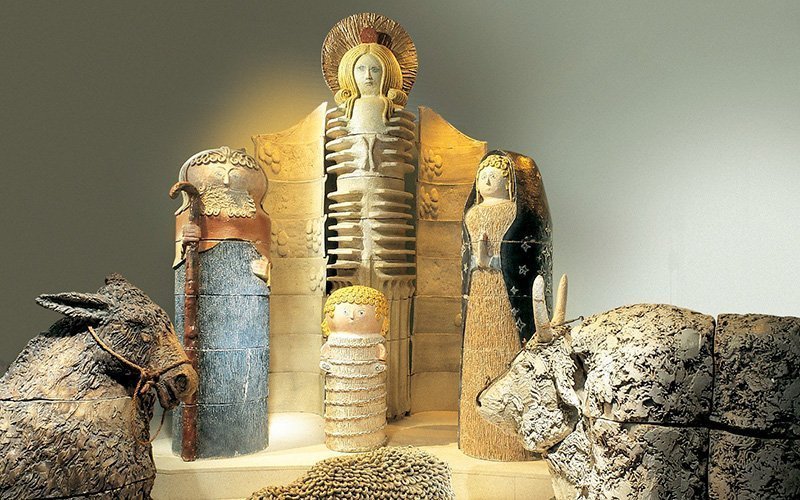
The figure in the middle of the scene, and has a halo, by the way, which according to Catholic iconography, is wrong because of the halo is supposed to be a saint, which would be Joseph (he is a saint) and Mary (she is a saint), and then, of course, the baby Jesus who is supposed to have the triangular halo, and none of these do, so it is inconsistent. The one in the middle (the angel behind them) is the one that is the center piece because it’s the object of the veneration. It’s also the jet or the pillar that is the backbone of what they say is Osiris. So, there’s who is being worshiped in this nativity scene. Then, of course, you have the previous ones.
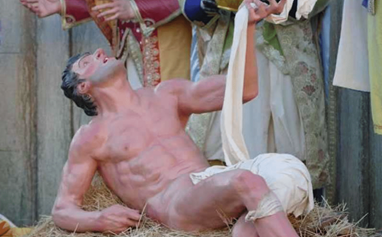
The Catholic Church knows very well that it is doing this, obviously. You had the previous one where you had the naked man up there, and that was a cause for outrage. But what doesn’t happen is that Catholics and Christians around the world don’t just say, “Wait a second! This is not okay!” Why don’t they? Because none of them have the will of Yahweh at heart because none of them have a Torah-based religion because none of them have the spirit of truth or the spirit of prophecy, but then they have the audacity to turn around and say, “Don’t judge me because God knows my heart,” or “It’s all just innocent; it’s just for kids.” How can just be for kids and how can it be innocent when you’re depicting naked flesh in the nativity scene? Is this G-rated?!
Elizabeth: You know, I’ve heard that so many times, “God knows my heart,” or “I do it for God. He understands that I’m not worshiping false gods. It’s because I love him that I do this.” Again, I’m sleeping with another man because I love you [Paul], even though you’re my husband. Yes! God does know your heart, and actually other people can know your heart too because if we are commanded to judge righteously with righteous judgment [John 7:24], we judge the tree by its fruit [Matthew 7:17-20], and we therefore, understand and know that what you’re doing, your works are actually what you are judged by [John 5:28-29, Revelation 20:12], and not by what your heart feels. So, if God says “don’t do something,” and then you do it, and then say you do it for God, I mean, that is a mockery, actually. It flies in the face of—if anybody were to do something for me that was abhorrent to me, and say that it is for me that they do it—if that happened to you, how would you even react? How could you even react to that without some form of anger or something to correct that behavior?
Paul:
[Proverbs 21:12] The righteous one observes the house of the wrong; he overthrows the wrong for their evil.
If you understand what righteousness is, then you may understand what evil is and still choose evil. You might do that; there are plenty of people that do. But to say that you can’t understand that this is evil because I don’t see what’s on your heart—the tree bears a certain fruit: grapes and thistles, I mean…
Elizabeth: But is it that “the mouth speaks of the abundance of the heart”? [Matthew 12:34] If you’re going around promoting the things that God has told you will end up in these ways that you’re seeing around you everywhere; they are connected. He said that if you do these things, then this will be the outcome. We are looking at the outcome of that. [Paul: Every action that you do] All around the place, everywhere you look you see this.
Paul: You don’t even need that symbolism that the Catholic Church puts and other Christian institutions and secularist institutions throw at you. But that it’s there necessarily means you can’t say that it’s hidden. You can’t say that you have some excuse for not seeing it. If you don’t see it, it’s because you don’t have the mind of God and you’re not paying attention. There it is in Jeremiah 10. What more do you need to know that the Christmas tree is a work of abomination, and that God detests it?
Elizabeth: Yeah, it’s relevant to everybody today, and actually in Jeremiah 16, it talks about God speaking to the people and saying that because your fathers have done these thing (and therefore, they’ve been taught to do these things as well) that he’s going to throw them out to a nation that they don’t know, and then when they want to return and they’re calling out to God and saying, “surely our fathers have inherited lies.”
Paul:
[Jeremiah 16:19-20] O יהוה, my strength and my stronghold and my refuge, in the day of distress the gentiles shall come to You from the ends of the earth and say, “Our fathers have inherited only falsehood, futility, and there is no value in them.” Would a man make mighty ones for himself, which are not mighty ones?
Elizabeth: Right, and that’s from the end of the earth. So, we’re not just talking about, “Okay, this is only for the Israelites in ancient Israel,” we’re talking about the end of the earth. This is long after the House of Israel has been dispersed for reasons that God said that he would do that, and Yahweh did do that, and this is part of the reason for that. So, again, if you want to cry out to God then you also have to admit and repent of the things that you have been doing, which means to turn back to his Law to what he tells you to do. It’s not hard to follow his Law [Deuteronomy 30:11]. It might be hard to stand up to tradition in the face of culture, but look at where your culture is leading you. Look at where your culture is leading your children. Look at where we are. How is it that people are fighting for the right to go out somewhere and to not wear a mask, even if they’re not sick? Why are they fighting for the right to go to work, even though there is nothing legally wrong with going out and working and being productive? We are in this place for a reason. It was actually told to us that this would happen if we were to continue to be disobedient. The way to turn that around, to heal the nation, for us to be saved is to simply to repent, which means to turn back to God’s law and do what he says.
Paul: In the Torah, it says that God tells us that he wants to have his law inscribed on our hearts, and we’re supposed to think about them when we go to bed and when we get up [Deuteronomy 4:9, 6:6-7, 11:19]. Sounds a lot like the day before Christmas, doesn’t it? The little kids go to bed thinking about, “Oh, I can’t wait to wake up and get my presents,” and the first thing that happens when they wake up in the morning, or wake their parents up early in the morning, just so they can unwrap presents.
Elizabeth: Speaking on that, the whole generational thing, and even where we saw where we read before, that after Joshua died, you start getting into further generations, and they get further and further away from God.
Go ask your kids what Christmas means. Go ask them what the importance is for Christmas. What do you like about it? What does it mean to you? And it’s all the commercialism, it’s all the consumerism, and the problem with that beside what is obvious, in this context, is that when you start thinking about “what am I going to get?” you’re thinking about things in terms of things, and that’s why things become more important, and people and relationships become less important. When you compound that with the online culture, where people are less important anyway, face-to-face, it’s a lot easier to treat people as things, and then you are creating the perfect soil and environment to have things such as pedophilia and drag queen story hour. And hey, my child is nine-years-old, and the judge says if I don’t give him hormone blockers, that he’ll be taken from my custody. It is related because one will naturally lead to the other because it changes the way that people in a social situation think about things versus objects. It actually has practical implications for the lives of you and everybody around you.
Paul: So, just getting back to Jeremiah 16 because we already know the Asherim are modern-day Christmas trees. There is no other way which society still practices this Ba’al/Astarte religion as overtly. I would contend that there are other ways that they practice it, but not in the substantial form of decorating their home, their places of business and public places, but right after Jeremiah declares “our fathers have inherited only falsehood” (and that means we have inherited only falsehood) and “would a man make mighty ones for himself, which are not mighty ones?”
[Jeremiah 16:21] “Therefore see, I am causing them to know, this time I cause them to know My hand and My might. And they shall know that My Name is יהוה!”
Then it goes on into chapter 17:
[Jeremiah 17:1] “The sin of Yehuḏah is written with a pen of iron, engraved with the point of a diamond on the tablet of their heart, and on the horns of your slaughter places
And before I go on, remember God wants his laws to be inscribed on our hearts [Jeremiah 31:33, Hebrews 8:10], and instead, we have the “the point of a diamond on the tablet of [our] hearts.” Think of the Christmas tree with the presents underneath the Christmas tree, and the kids literally kneeling in front it—literally kneeling as though it were an idol because “it’s so benevolent. It gives us these heavenly gifts and we open them because they’re finely decorated,” and like it says here, “the greatest craftsmanship” of the people who make these things—the decorative paper and the bows and all that—is put to shame by Yahweh. Then they open them, and be like, “Oh, thank you Santa Claus,” or “thank you Mom and Dad, or whoever gave this to me,” but it all happens under this tree which has this star as the crown on the top. This star, if you know anything about this, represents the angel that announces the birth of Christ, and sometimes you’ll see in the homes of Christians decorating the tree (in secular society, you won’t see this)—at the very top, at the apex, at the eye of the pyramid—an angel, the messenger, “the voice of God”, the Metatron. It’s despicable.
But anyway, I was saying…
[Jeremiah 17:1-5] “The sin of Yehuḏah is written with a pen of iron, engraved with the point of a diamond on the tablet of their heart, and on the horns of your altars, while their children remember their altars and their Ashĕrim by the spreading trees on the high hills. My mountain in the field, I give as plunder your wealth, all your treasures, your high places of sin, throughout all your borders. and you, even of yourself, shall let go of your inheritance which I gave you. And I shall make you serve your enemies in a land which you have not known, for you have kindled a fire in My displeasure which burns forever.” Thus said יהוה, “Cursed is the man who trusts in man and makes flesh his arm, and whose heart turns away from יהוה.”
Elizabeth: Doesn’t sound very benign to me.
Paul: God hates this holiday; he hates these customs. There is no forgiveness in this. The only message of any sort in the prophets (or in Torah) that has anything to do with God being benevolent about this whole observance (whether it’s the Christmas day or the things that surround it) is that he’ll be merciful only if you repent and cease in the activity, and that’s it.
Let’s go to Deuteronomy chapter 28. This is kind of a long one that we could read too. How about you [Elizabeth] pick out some highlights, or do you want me to do it?
Elizabeth: I’ll go ahead…
Paul: I would recommend that you [the reader] read the whole thing in its context, but let’s just pick out a few highlights.
[Deuteronomy 28:1-2] “And it shall be, if you diligently obey the voice of יהוה your Elohim, to guard to do all His commands which I command you today, that יהוה your Elohim shall set you high above all nations of the earth. And all these blessings shall come upon you and overtake you, if you obey the voice of יהוה your Elohim”
Elizabeth: I would like to point out that the founding of America, and the people who founded it (in some of the historical documents that we have) recognized that God is God. They wanted to create a system that was based on the law of God. Whether they had it perfect or not, they were trying to make it perfect. Everything they did had God in mind. So, the idea of separation between church and state is kind of a funny thing because even if you don’t have a state religion (or a government-issued religion), the types of laws that you create are going to be based in what your spirituality is and what your idea of morality is. So, the laws that were created at the very foundation even of this republic is based on the idea of the law of God.
Paul: And the blessings which Yahweh says will overcome you or overtake you apply to you whether you’re in a city or in the field, the fruit of your body (and, of course, that means your health, your offspring, and even just not being lethargic having vitality); just enjoying life and getting those most out of it.
“The basket and your kneading bowl” [Deut. 28:5] (both the food that is on the table and whether it is in your stores), “when you come in, and you go out” [28:6] and, “he causes your enemies to be smitten” [28:7] and, “your storehouses are full and blessed” and “he blesses you in the land” [28:8] and, “all of the nations of the earth shall see that the Name of יהוה is called upon you, and they shall be afraid” [28:10] and, “he will make you the head and not the tail” [28:13], and, “He opens His good treasure, the heavens, to give the rain to your land in its season, and to bless all the work of your hand. You shall lend to many nations, but you do not borrow” [28:12] Wow.
Elizabeth: Right.Does that not sound like the opposite of what we have in America right now? But it’s not what we did have in the beginning.
Paul: And, of course, they had to work, but what greater gift—okay, you get a little dopamine rush when you open that present, and you see “oh, my parents actually got me what I wanted,” or so and so if you’re an adulterer—compared to life, liberty and the pursuit of happiness—compared to the rainfalls and the crops growing and you don’t starve!
Elizabeth: Unheard of in any other place and in any other government—both of those things. In fact, I’m sure you can find some documents that refer to the United States of America in its early years as being the “new promised land” because they did understand that America was a promised land.
Paul: The Pilgrims and the Puritans knew exactly what they were doing when they came here, and frankly, I think they were right, but that doesn’t mean that we haven’t lost that inheritance because of these abominable pagan practices as it says in Deuteronomy 28:
[Deuteronomy 28:15-18] “And it shall be, if you do not obey the voice of יהוה your Elohim, to guard to do all His commands and His laws which I command you today, that all these curses shall come upon you and overtake you: Cursed are you in the city, and cursed are you in the field. Cursed is your basket and your kneading bowl. Cursed is the fruit of your body and the fruit of your land, the increase of your cattle and the offspring of your flocks.
It is just the total inverse of all the blessings.
[Deuteronomy 28:21] יהוה makes the plague cling to you until He has consumed you from the land which you are going to possess.
Elizabeth: That’s a funny thing to say in 2020.
Paul: And in 2021. Let’s talk about the future because these plagues are not finished.
Elizabeth: What does it mean to be “cursed”? The fruit of your body is cursed. I mean “cursed” means to be cut off. How many children need to be slaughtered to realize there is a curse there?
Paul: Or how many children need to be cut-off by not being born because of sterility caused by a certain “medical intervention”—60%-70% according to one doctor, a professor of medicine at Oxford University.
Elizabeth: That’s not even a direct choice for the fruit of your body to be cursed. It’s an indirect choice for the fruit of your body to be cursed there.
Paul:
[Deuteronomy 28:22, 24] “יהוה smites you with wasting disease, and with inflammation, and with burning, and with extreme heat, and with the sword, and with blight, and with mildew. And they shall pursue you until you perish. יהוה makes the rain of your land powder and dust; from the heavens it comes down on you until you are destroyed.
So, we have dust bowls that are happening in this country instead of rain, and it happened because of the mismanagement of the land because of banking (the fractional/federal reserve system), we have had wars. This is now three world wars in the last hundred years.
[Deuteronomy 28:28] יהוה shall smite you with madness and blindness and bewilderment of heart.
You can read it for yourself. It’s not pretty.
Elizabeth: You can see plenty of that in the memes going around.
Paul: Suffice it to say, that if you obey God it will be well for you, and if you don’t it won’t, and that applies both to the nation and to the individual or the family unit. God also says that if my people are called by my Name shall repent, and all that. “Do my will and I will hear from heaven and I will heal their land” [2 Chronicles 7:14]. That hasn’t happened yet, has it? We’ve been praying as a nation for salvation, and this is why we don’t have it. This is why we are still waiting for justice and mercy and we have nothing on the horizon to expect, but more plagues and the Great Reset and total impoverishment and enslavement and the boot stomping on the face of humanity forever because we have not turned away from unrighteousness. We have not turned away from sin. We have only asked God to intervene. Whether or not he does will depend entirely on whether or not we listen to and obey him. God does not hear the prayers of the unrighteous [John 9:31, 1 Peter 3:10-12, Isaiah 1:15-16, Psalms 5:3-5, 18:41, 34:12-16, Proverbs 15:29].
Elizabeth: So, what you see, if you really look at it, is that people are praying to end the curses that have been promised that you are reading about there, but those are the curses or the outcomes. People are praying for the outcomes to stop, but what they really need to do is believe God. So, if you believe in him, then you believe him, then all of this can be ended and the nation can be healed. Everything can be turned back around. America can be saved; your family can be saved—everything can be saved and be healed—all you have to do is listen to God. That doesn’t mean listen to somebody’s sermon who is going to make money off of it and then go and put some presents under the tree, or whatever. It means God says don’t learn these things, don’t partake in these things, don’t try to worship me the way they [the pagans] worship their gods. He doesn’t just say “don’t worship their gods,” he says, “don’t worship Me the same way they worship their gods” [Deuteronomy 12:30-31]. If you just listen to him and do those things and teach your children to do those things, then this can all be turned around. This can be saved, and I think a lot of people will turn because it says “that they will say ‘our fathers have inherited lies,’” [Jeremiah 16:19] and that means that they will understand it.
Paul: And “my people are destroyed for lack of knowledge” [Hosea 4:6]. The reason that we don’t have more people repenting and turning to God and abandoning these pagan practices is that they just don’t know and they need education, and it is up to us, including you, to educate them. Did we read Jeremiah 10 yet?
Elizabeth: Yes.
Paul: Okay, so we’ve already covered the Christmas tree, decorations and ornaments. You can apply the same thing to lighting arrangements that they didn’t have back then because they did do those kinds of things. They did have torches and used fire to light up their abominations, as we do now. I can’t tell you how many times I’ve gone by a house and seen that they have some Santa Claus things, or whatever. God doesn’t take pleasure in any of that. God would just rather you not observe this pagan festival at all.
[1 Kings 11:5] And Shelomoh [Solomon] went after Ashtoreth the mighty one of the Tsiḏonians, and after Milkom the abomination of the Ammonites.
Milkom is Milqartu (Akkadian) or Molekh—the Ammonite Milkom is the Canaanite Molekh. So, Molekh is the child-sacrifice god. As I said, this Molekh (as Ba’al) is the consort of Ashtoreth, or Astarte or Ishtar. The goddess Eostre (Easter) is literally married to Molekh.
Elizabeth: The very first one listed there is saying that he went after Ashtoreth, and if we’re talking about Solomon, then we’re talking about this “great and wise” king. Israel was “the best that it ever was” at the time, and turned around so quickly just because of—well, other things too—because of that. It brings out that the main reason why is because he went and followed Ashtoreth. So where would we draw the line where Solomon will lose his entire kingdom and all the great things that he did over this, but we can do it a little bit and we’ll be fine? That’s a real question. Think about that. Where can you draw that line where, “well, it’s okay if I just disobey a little bit, and I have my Christmas tree still, and I love my family and I love the gathering, and the nostalgia and all of this,” (which actually is a drug which will end up hurting your children in the future the way that it hurts you now that you’re unable to turn around from this)? But where is it okay to say, “well, he said not to do this, but if I do it a little bit it, will be fine”?
Paul: And Solomon didn’t order people to do it in their own homes. The culture of the Israelites did not have them doing it in their own homes. It says he built the high places, right? It continues, as you said, the first abomination (and, of course, this is a list of the abominations, and it’s even Milkom, the abomination of the Ammonites) it doesn’t say that Ashtoreth is the abomination, but it does say that about Chemosh of Moab and about Molekh of the children of Ammon, etc.
So, you have the list of abominations in 1 Kings that Solomon set up at the high places, and now people, especially Christians will put them into their own homes. The very first one that is mentioned is the abomination of Ashtoreth, which is the Christmas tree as it is now. It’s taken a slightly different form, and maybe we’re not performing a human sacrifice on it, but we are certainly sacrificing everything that God tells us not to. We are sacrificing his law. We’re not obeying his law. We are sacrificing his Name and authority. We are sacrificing our inheritance and our children [Elizabeth: Their future, OUR future; the future of the nation] for a Christmas tree or a present.
Elizabeth: For just a little bit of disobedience, for just a little bit of sin— “sin in moderation,” right?
Paul: And it says right there, after verse 5, it says, “then Solomon did evil in the eyes of Yahweh.” It’s called evil. The Christian religion, is of course, evil, but the practices of Christianity are what make it so. It is willful disobedience when God says “do not do these things” and then they go ahead and do it. That’s what is evil in the eyes of Yahweh, and then justify it. And they tell us, “It’s just innocent. It’s just for kids” or whatever. Let’s address that.
Elizabeth: “Just for kids”, mhmm. Why would you want to show your kids the wrong way? If you want to get gifts for your kids, then get them gifts. What child asks for bread and their father gives them a stone [Matthew 7:9]? Give gifts for your children and love them. Give them what’s appropriate.
Paul: No gift is more precious than the gift of knowledge and of life—and God is the god of life, and of love, and if your children are taught to love and they know what it is to be loved, then they will not have to worry about sin and all of the disenfranchisement from family and from God.
[Proverbs 22:6] Train up a child in the way he should go, even when he is old he turns not away from it.
And incidentally that is right before “The rich rules over the poor, and the borrower is servant to the lender.”
Elizabeth: You train them to do things that are disobedient to the Maker, the one who created them, then they will not depart from the way of disobedience. It’s not just a particular thing, either. It’s an entire mindset.
Paul: I’ve been reading a lot from the Old Testament, but here is Ephesians 6:4
[Ephesians 6:4] And you, fathers, do not provoke your children, but bring them up in the instruction and admonition of the Master
So, to teach them in the way Yahshua is antithetical to provoking your children.
[Matthew 18:6] But whoever causes one of these little ones who believe in Me to stumble, it is better for him that a millstone be hung around his neck, and that he be drowned in the depth of the sea.
Is it really so innocent to teach your children to venerate Santa Claus, or to indulge in a materialistic and overly commercialized society?
Elizabeth: I am reminded of a verse, but don’t remember where it is, that says that those who do not have God’s law are like blind men stumbling around in the middle of day and that sin is a stumbling block to them [Deuteronomy 28:29, Isaiah 59:10]. So, sin can be a stumbling block to your child as well, and if you love your child and if you love God, then in both instances, you would train them to be obedient to God because that’s what is going to cause them to be blessed.
Paul: What do you say to the Christian who says, “It’s okay. It’s just tradition. We don’t really believe in it, we’re just doing it because our parents did it”?
Elizabeth: It’s a cop out and a justification.
Paul: God is not going to hold your parents accountable for what you do [Deuteronomy 24:16, Ezekiel 18:20].
Elizabeth: Actually, what that says to me is what anybody says something like that is, let’s say you went out to rob a store and say it’s a tradition and come from a family of thieves, do you think it’s going to be less of a law for you when you get caught robbing the store?
Paul: Maybe if you live in Seattle. It’s okay to steal as long as it’s to pay for ends meet.
Elizabeth: Again, that is a culture that is intricately linked and connected to Christmas because it is a culture of disobedience to God, and it has these fruits from that tree.
Paul: In response to that argument, the “tradition = it’s okay” (which we’ve already thoroughly demolished):
[Matthew 15:3-6] But He answering, said to them, “Why do you also transgress the command of Elohim because of your tradition? For Elohim has commanded, saying, ‘Respect your father and your mother,’ and, ‘He who curses father or mother, let him be put to death.’ But you say, ‘Whoever says to his father or mother, “Whatever profit you might have received from me has been dedicated,” is certainly released from respecting his father or mother.’ So, you have nullified the command of Elohim by your tradition.
Sounds like Christmas again, doesn’t it?
Elizabeth: Right, it does, but again, that isn’t just people who say, “Well, we only do it because it’s tradition,” that also includes the people who say, “No, it must be right because it’s the tradition of the Church.” The thing is, Yahshua (or Jesus) was going against the traditions of the church of that time (and it wasn’t called the church, it was called the synagogue, or whatever you want to call it), he was pointing out that the traditions are not set by the religious body, so therefore for you to say, “well, there’s no such thing as sola scriptura, and all of this, therefore, since it is a tradition of the Church, then that’s what we’re supposed to do because this is what the saints passed down, and so on and so forth.” [Paul: the saints whose tombs are garnished just like they do to the Christmas trees] That is the exact type of an argument that the Pharisees et al were leveling towards Jesus, and he said, “No! You can’t nullify God’s law and the Word of God with your traditions,” although that is what they were doing respectively with themselves, but you can’t get rid of the law with tradition.
Paul: How many people practice the tradition?
[Matthew 7:13] Enter in through the narrow gate! Because the gate is wide – and the way is broad – that leads to destruction, and there are many who enter in through it.
That’s where your tradition is leading you. It’s better to break away from it than to justify it.
Elizabeth: Right, and it’s not easy because not only are you fighting nostalgia (and it’s a form of a drug), not only are you trying to find something else to fill that void [Paul: that’s why it’s so insidious because you’re training your children], but you’re also going to come up against a lot of resistance from people who know you and who surround you and who are going to call you names and ask you, “What’s wrong with you?” And say that you’ve gone all “conspiracy theory”, and all that. But in reality, just look around you. The promises are coming true. The promises will come true in the other direction as well.
Paul: The promises of both the blessings and the curses. We are blessed. We are not out of a job or anything like that. Tell about the co-worker whose child’s faith was rattled. Remember that?
Elizabeth: Years ago, I had a co-worker who was just visibly upset. She didn’t know what to do. She said, “You know, my son,” (I think he was nine at the time) “My son just heard that Santa Claus is not real, and he said to me, ‘Mom, I was told that Santa Claus isn’t real, but I don’t know what to think because you told me that he’s real, and I know that you’d never lie to me.’” So, she didn’t know what she was supposed to do, and lying is not something you are supposed to do.
Paul: I think the main thing to take away from that is that it is better to always be truthful. Everyone finds out at some point in their lives that Santa isn’t real. There’s no way you’re going to perpetuate that lie throughout your child’s entire adult life. You are going to lose their confidence at some point. Even if they just look back and say, “Oh, well, it’s just normal to lie to kids,” is that the kind of society you want to live in? Do you think that’s what it means to be set-apart to Yahweh Elohim to have that kind of fraud being pulled on people, and that’s normal? Especially when we’re talking about a pagan deity.
Let’s go back to that. So, this is probably the number one justification that I’ve heard from Christians as a blanket statement applied to all the paganism within the Church: and they say, and I can’t believe I’m even uttering the words, that the incorporation of the pagan rites, beliefs and symbols constitutes a victory over them. I will let you [Elizabeth] respond to that if you want, but first of all, what is a victory? You have the Roman triumph (I’ll leave that for a later date, but that is the canonization ceremony where you become a god and all that), but victory—Constantine worshiped Sol Invicto, the invincible, the undefeatable, the indomitable sun, whose day was December 25th. How can it be a victory? The victory is of paganism over Christianity, not vice-versa, obviously. So, Mithras is literally the Anti-Christ—Jesus Christ is the Anti-Christ because he is the “christ” in place of the Christ. He is the Roman god in place of Yahshua the man and Messiah of Israel. Prove me wrong.
Elizabeth: Let’s just take a logical step here. When you’re talking about these customs, and such, when Yahweh was explaining to Israel what they should and should not do, he also said that there is one law for the foreign-born and as well as for the Israelite [Exodus 12:49, Leviticus 24:22, Numbers 9:14, 15:15-16]. In other words, between people who are Israelites by blood and who were not, there is to be one law among them. So, you don’t have a law for the Gentiles and a law for the Israelites. There is one law that should govern them because it’s God’s law. He also said to use judgment to be set-apart, to be able to discriminate between what is set-apart and what is not, and to not mix with those things.
So, if there is one law for everybody, and if you are following God’s law and not the law of man (because it’s always one or the other—the law of God or the law of man). When it comes right down to it, it’s humanistic in every type of way, there is no way that you can be following God’s law and breaking God’s law at the same time. There’s no logical way to bridge that gap. [Paul: “I’m robbing a bank, but I’m a law-abiding citizen!”] You have to realize that in order to be a subject of God, to be a child of God, to be a servant of God, to call upon the help of God to come and save you, for you to listen to God, then you have to listen to God! If you believe God, then you have to believe what God said. Do what he says. To say something like, “Well, in our incorporation of these things shows triumph,” it’s like double-speak almost.
Paul: If it’s a triumph, then why is it still existing? The entire system of Christianity is simply “obey the law,” that’s what it all comes down to. There is, of course, repent and maybe some baptism, or whatever, to show your repentance, but it all comes down to the same thing. God had an idea of how we’re supposed to live our lives. We are either doing that or we’re not, and Christians are all obligated to do that very strictly as a matter of fact. But because Christians reject the law, why is there no incorporation of any element of Christianity into the pagan system? Yet, the entirety of the pagan system is preserved intact, and yet, it’s a “triumph of Christianity over paganism”? It’s the most absurd thing I can imagine. It’s like the Vikings are playing the Packers, and the Packers win 68 to zero, and the Vikings say “we’ve won.”
Elizabeth: Right, and you can’t incorporate those traditions and those kinds of things, and then say that you’re a subject of Yahweh, and that you’re following God and called by his Name, because you’re not. He makes it very clear, I think, that it is not the way it’s supposed to be done, and we want for that to be done. I want for that to be done as well, and I’m not saying, “Hey, go out and find the nearest person who thinks he knows a lot about God and ask him what to do,” I’m saying read your Bible and just read what it says to do. Start with the Ten Commandments and move on from there. Start with refusing to follow pagan customs because it can’t be any clear. I don’t know that a text that has survived for thousands of years could have remained so clear in its objective to tell people not to do that thing. I mean, we even have fights over what the Second Amendment means from a couple of hundred years ago. This [the Bible] is from a couple of thousand years ago and it’s still very clear.
Paul: It describes the ornaments and the garlands and the way the tree was set up, and how they hew the branches to make it fit.
Elizabeth: And even if it’s not describing perfectly a Christmas tree for some people in their minds, it’s still describing ways in which we should not worship God.
Paul: Why risk it? If the Bible says this is an idol, then why would you have something that looks like a duck and sounds like a duck, and then say, “it’s not a duck,” even though I’m putting it prominently on my window so that the neighbors can see it.
Elizabeth: …and create new ones, like the elf on the shelf.
Paul: Oh my gosh. So, I wanted to actually mention the elf on the shelf, thank you. I’ll just ignore it, but we did have a passage relating to that, but I guess we’ll just skip it, but it’s a new custom, isn’t it? And that is something that is talked about in Scripture.
Elizabeth: Well, newish. New compared to how long this has been going on.
Paul: New compared to where it’s first announced in the prophets, but they said, “no new customs.” Anyway, just wanted to say that there’s an element in the story of the nativity of Christ. Just try for a moment to dissociate between Christmas and the Christmas story as it is told in the Bible (and by “the Christmas story” I mean the birth of Christ. I don’t mean Christmas because the two are completely separate concepts). To Constantine and anyone worshiping Mithras, it’s the sun goes down the horizon and comes back up, and then you have the seasons. So, the solstice is the beginning of the time period where the days are lengthening, and that’s what it’s all about.
But as far as what is in the Bible, we have a couple of problems. One, the story of the birth of Christ is only depicted in one of the four Gospels and nowhere else in the Bible, and that’s in the book of Luke. I don’t think it was coincidence that Luke was the one Gospel that was sanctioned by Marcion, who informed the Roman Christians about what their beliefs were supposed to be. I’m not going to get into any conspiracy theory about that. That is for a different time, but it’s something to think about.
Elizabeth: Well, I think it is something important to bring up. One very quick thing about Marcion (and this is something that everybody should study who actually believes this doctrine that Jesus came and kind of did away with the Law and has a new Law) is that Marcion viewed Yahweh, the creator god in the Old Testament, as evil and against the loving Jesus. So, if you didn’t know that, it’s a very real thing. You can look it up and find information on it. You can find it in academic journals, and everything, that’s actually the case. That’s a lot of where the concepts of modern-day Christianity came from.
Paul: It puts the very authenticity of the story into question. I’m not going to say the story of the birth of Christ as depicted in Luke is fraudulent, but I am saying that it’s something that people should probably consider before they associate their Messiah with the holiday.
Another thing too is that there is another story, and that is—let’s assume that the angels are announcing the birth and the annunciation of Gabriel to Miriam is legit, and all of that, and the wise men from the East (even though there’s no way that happened on that date; there is no way the Magi showed up on the day he was born—not possible), but let’s just assume it’s all part of the same story, and so it’s important. The Magi went to visit Herod, and what they told him was that this prophesied Messiah was going to be the king of Judea, and he decided, “Well, I’m the king of Judea, so we can’t have that,” and so he tried to murder him. I would say that as much as Herod intended to blot out Christ from existence, Christians have done that by replacing him with Mithras. I think Christians have succeeded where Herod has failed, and I think Christmas is a big part of that.
Okay, so let’s just read a few more and then wrap it up. What would Yahshua want? Let’s say if Yahshua was up there in the heavens somewhere observing us, and he comes back someday in glory on the clouds and tells people who say, “Haven’t we prophesied in your Name and done all these works in your Name” and says, “Get away from me. I never knew you because of lawlessness.” [Matthew 7:22-23] What would he actually expect of us with regard to the Christian holidays, and in particular, Christmas?
Elizabeth: To follow the Law
Paul: To follow the Law?! Wow! So, to turn to the Torah and worship Yahweh, instead of him [John 4:23-24], and maybe all the time instead of one or two days out of the year.
Elizabeth: The same thing prophets said throughout the whole Bible, “Turn back to the ways of your Father” [2 Kings 17:13, Jeremiah 6:16].
Paul: But where does that leave Christmas?
Elizabeth: It leaves Christmas completely, goodbye. And what do you’ve got to lose, right?
Paul: Thank you. That’s what I wanted to hear. There’s no redeeming the Christian holiday of Christmas. There’s no salvaging it. Just throw it out the window, and that doesn’t mean throwing the baby out with the bath water because the baby Jesus is an important thing for us to look back to in realizing how we got to the point to where we can be redeemed. I do believe this is very, very important. Not necessarily the nativity, but more like the life and teachings—the renewed covenant at Passover—these things are important to our salvation. What’s not important to our salvation the birth of a baby. Sorry, Yahshua, I love you, but it’s not that important. Your birthday doesn’t matter to me. We don’t even have the right date.
Elizabeth: Or to practice the customs of the nations around that baby that had nothing to do with him.
Paul: Frankly, they’re worshiping Horus, I mean it’s the Isis/Horus figure, going back to Tammuz, Nimrod, or whatever.
[Leviticus 24:22] You are to have one right-ruling, for the stranger and for the native, for I am יהוה your Elohim.
Like what you [Elizabeth] were referring to earlier. That’s what Yahshua wants of us.
Elizabeth: Right, if you’re supposed to have one law for the stranger and the native, and even if you want to take it to the New Testament level and say, “Okay, well the Gentiles are grafted in.” If the Gentiles are grafted into the tree, then that one law still has to exist, and it has to exist for both of them which means you should not be doing these things.
Paul:
[Exodus 12:49] There is one Torah for the native-born and for the stranger who sojourns among you.
Ok, so we’re talking about the celebration of the birth of Christ. I’m not against it. I think it’s a good thing to celebrate, just like we can observe birthdays. I like to give my kids gifts on their birthday and tell them it’s a special day because they’re important, and to show them that they’re loved and not taken for granted. I think we can do the same thing with Yahshua. I think he deserves it, but not because he redeems the world, but because God kept his promise to deliver us out of the hands of the wicked rulers, and that doesn’t apply if you haven’t been delivered and if you’re still doing the ways of the wicked rulers and the pagans.
Elizabeth: Right, you’re still lending your power and giving your authority to the people who are oppress you—who are putting that boot on your face, who, by the way, are telling you that you can’t celebrate Christmas this year. It’s pretty ironic. Okay, so you can’t celebrate it anyway so you mind as well just turn to God and do what he says.
Paul: Take the hint. This is your opportunity to repent.
Elizabeth: And to me, that signals that maybe God did put those rulers over us in place.
Paul: So, I am not against celebrating the birth of the Messiah. I think it’s a very important moment in human history. I think what is more important is that we get ourselves right with God, otherwise all of that is academic. It doesn’t matter and it doesn’t help us.
Elizabeth: That’s the core of the entire story. It’s the core of Yahshua’s story, of all of the prophets, of the love story with God. The central component is to love God, and what does it mean to love God? To follow his commandments because the way that we behave is the way that we express who we really are and what we really think.
Paul: So, I’ve already said that there’s nothing to salvage from Christmas and there is no reason to follow it, but I realize that if you’re getting away from this Babylonian religion, then you’re going to have a hole or a void where the sentiments that are associated with the nostalgia from your childhood, from the get-togethers with your family, from the church services, and all of this different stuff—the music, the atmosphere, the movies, and the culture. It helps to have something to replace it with.
So, the question that you might ask me, which I will preemptively answer, is “can we replace it?” because I’m saying throw it out; she [Elizabeth] is saying throw it out. There’s no reason to keep it. I would say, how would you replace it? Do you want to replace it with a better calendar date, like in September instead of December, or something? No! Forget it. Just follow the law.
Elizabeth: How about replace it by helping the poor, fatherless and the widows? How about spending your time doing things that actually matter to people?
Paul: Yeah, true religion in which God the Father likes is to keep oneself unpolluted from the world and well as looking after the fatherless and the widow [James 1:27], but I would say that if you want to replace it then you have the wrong approach. Try observing the feast days and the sabbaths before you say, “I need more festivity.” This is the fundamental core problem that people have, and why they have chosen this other way because they haven’t followed God’s law.
Elizabeth: There are more feast days than there are Christian holidays, and I don’t know if many people even know that they still exist. They think that they are Jewish holidays, which is actually not the case. It was given to all of the Israelites. A Jew comes from Judah, which was one tribe out of twelve tribes, and there were ten tribes that left, which was the northern house of Israel later. As a matter of fact, Israel was at war with Judah, if you say that the Jews are Judah (that’s an if). So, they are so separate. Those feast days are not “Jewish holidays”; they are God’s feast days—Yahweh says they are His feast days, His sabbaths, not any persons or a group of people.
Paul: No expiration date, no expiration event.
Elizabeth: And he has particular things to do in them, but they’re supposed to be sabbaths, I mean, real holy days or set-apart days. So, you can replace them with the real feast days, absolutely.
Paul: I’ve seen Jews mockingly brag to Christians that they get presents for a week on Hanukkah, which is a big thing in Judaism.
Elizabeth: Hanukkah [and also Purim] is a Jewish holiday. It’s not one of the feast days.
Paul: No, obviously it’s an abomination itself, and maybe next year we’ll do a video on Hanukkah, but in any case, that’s one. There are festivals in the Torah that last for a week, for example, earlier this year we covered the Feast of Unleavened Bread, which is seven days. You’re worried about one pagan holiday? I don’t think your heart is right with God if that is the case. I think it’s better to just make a clean break, to come out of Babylon, to not partake in her sins and the plagues that derive from them [Revelation 18:4, Jeremiah 51:45]. Maybe this will create a rift between you and your family, but remember Yahshua said, “I did not come to bring peace. I came to bring a sword and to divide a household” [Matthew 10:34-36]. If you’re household isn’t divided, then you’re on the wrong side. You’re not going to have a household that is 100% completely, with extended family, all observing the Torah and following the feasts of Yahweh.
Elizabeth: Think about where you are in terms of these things. Are you on the same side as the person who is pro-abortion and the like? Look at where you are culturally and socially and where you stand with people who stand against God, and what does light have to do with darkness [2 Corinthians 6:14]?
Another thing that I would suggest is maybe that if, to say for example, if you go to church, and you missed going to church because it’s like being in a club; you would miss the people that you would see on a normal basis. Well, why not have a Bible study at your house actually reading what the Bible says and to learn what the Law is actually teaching people? Because even if you know it, there are other people who don’t know it, and they would love to come and hear what the Word of God actually says.
Paul: I would say be a witness to those people at your church, or whatever, and if they don’t accept you or if they don’t accept the words of Yahweh, then maybe it’s time to get new friends.
Elizabeth: Right, and if people challenge you based on what it is that you find (if you have Bible readings, group discussions, or even on your own), the mind sharpens the mind. If they have objections, then you go back and learn why those objections are invalid or maybe valid, and it helps to form your idea of what truth really is because truth will always stand up to the lies.
Paul: And, of course, if you have any questions that you think that we can answer and need answered, then you can leave them in the comments to this video and we’ll do our best to get to them. Unfortunately, YouTube is not allowing me to answer comments, but I have a way of working around it sometimes, and sometimes it works and sometimes it doesn’t. So, I will probably be putting all of my videos on a different platform. This will be originally posted to YouTube, but it will probably go to GabTV, and hopefully it won’t have to go anywhere else because hopefully free speech under that platform will always be protected and not persecuted.
In the meantime, I have just two more passages that I want to read and to leave with. It’s something to think about.
[1 Samuel 7:3] And Shemu’ĕl spoke to all the house of Yisra’ĕl, saying, “If you return to יהוה with all your hearts, then put away the foreign mighty ones and Ashtaroth from among you, and prepare your hearts for יהוה, and serve Him daily, so that He delivers you from the hand of the Philistines.”
Or the Democrats or the Chinese (what’s the difference?)—the government. That’s important, I think, because we have to realize that as far as we are coming to the crucial moment of our deliverance (very soon, hopefully) we still got a long way to go. Our nation of America, the Western civilization, and the world as a whole will not be saved. That was never in God’s plan, never for a moment. The weeds and the wheat are going to be harvested at the same time.
So, we have the plan that God has told us about through the prophets is to save the remnant that he has sealed unto himself, and what that necessarily means is that not all of the nations on earth will be persecuted to the same degree. Not every single person who calls on the Name of Yahweh will not have deliverance. Obviously, those are the people who will have deliverance. However, I think it’s important that we realize (and I say this as an American, and to some degree, I would say as a patriot) that we are not going to be delivered to the extent that many people would like, and this is why:
Cue the image of Donald Trump, or better yet, Melania doing the Christmas decorations at the White House, and there you have it.

So, our last passage:
[Isaiah 54:14] In righteousness you shall be established – far from oppression, for you shall not fear, and far from ruin, for it does not come near you.
In righteousness.
Elizabeth: Right. What do you have got to lose? A lot of people are probably Trump fans because they view him, kind of what Yahweh spoke about before, as one of the rulers that would save you from the oppressors from too much oppression. Remember, he said to the African American community, “What do you’ve got to lose?” Well, look around you. See what’s going on. See all of these people who confess Jesus as their Lord and Savior and see what’s still going on, when they practice everything they do anyway.
Anyway, what do you have to lose? Follow God. Do what he says. See if he’s telling the truth. God tells the truth, he doesn’t lie. When he says he’s going to do something, then he will. If you listen to him, if you follow his Law, if you reject these pagan traditions and customs and turn back to what he says to do, he will heal you, he will bless you, and hopefully with enough people, crying out to him and doing as he says he will heal this nation and heal this land.
Paul: And it is God doing that. It’s not any man or any group of men, and they’re not even capable of it. They are being used as instruments by God to affect that salvation, not for themselves, but for us. Not for the world, not for our nation, not for our society, but for us—the chosen ones that he has decided to redeem and to seal.
So, I think it’s important to realize that, and if you need any proof, then we’ve got the pictures and whatever, of the Christmas tree and all that. We’ve got the Christmas messages; “Merry Christmas” and they observe that—and if they don’t, it’s because they’re observing other holidays. You have the people who are close to the President that are Jewish. You have the Jewish Catholics (they’re all Catholics). [Elizabeth: Well, the prosperity people] Yeah, Kenneth Copeland—these people are horrible and abominable and they practice abominations. By Scriptural designation, they are all wicked. Even though they may not be seen as such, God can use them the same way he used Cyrus to liberate us, but it’s still up to us to not go their way. The next battle that we fight after the Illuminati are deposed will be against our own rulers that delivered us from them because they are the ones who are going to perpetuate and continue to teach us these lies and to inform us that these practices are okay.
When the Supreme Court of the United States decides to protect religious freedoms, they are protecting their own freedoms (they are all Catholic). Neil Gorsuch, Brett Kavanaugh, Amy Coney Barrett—they’re all devout Catholics. I don’t care how devout you are, your religion is false. Your gods are Satanic. Your practices are from antiquity of child sacrifice and other horrible perversions, and God will destroy that in the end along with everything else. I don’t care how well you decorate your tree; it will decay. I don’t care how well you adorn your churches; it will burn in the fire. What will endure is the Word of God and those to whom he has decided to give everlasting life. You will not have that if you choose the way of death.
Sound like a good prophecy? Can we end it there?
Elizabeth: I think so, I mean because it is the prophecy of God through Moses, right?
Paul: and Yahshua. Alright, thanks for tuning in. I hope this was informative. I hope that your spirit is refined and kindled and you’re going to come away this holiday season, or whenever you happen to view this video, thinking, “Well, I’m glad I made that decision” because the last thing you should ever do is regret obedience to God. I was raised that way, and I have no nostalgia and no regret of family get-togethers and all that stress and hardship.
Elizabeth: Most people don’t currently when they know, “Oh, I have to go see my family,” and some people love to see their family, but for the most part, yeah, “I have to go see somebody I haven’t seen in an entire year and pretend like we have some kind of a relationship.”
Paul: Why do you need a calendar date for that? This is the best gift of all. [Paul wraps his arm around Elizabeth] Share the love, not of the holiday season, but of the blessings of life lived with God as your sovereign.
Download a PDF (formatted with wide margins for smartphones)
 kohreinur.org