For centuries Christianity has taught that Jesus practiced the religion of Judaism and that he and his parents were Jews. There is no evidence in the Bible which supports this claim and in fact the Bible proves that he was not Jewish and was opposed to Judaism. This article will present the Biblical and historical evidence to prove that Jesus was not a Jew and will explain who he really was, but before we can discuss the identity of Jesus, we must discuss the difference between Israelites and Jews.
Judaism began after the return from the sojourn in Babylon caused by the apostasy of Israel lead by King Solomon (1 Kings 11). This is why the Oral Law is known today as the Babylonian Talmud because it is inspired by the religion of the Babylonians. Jews are a by-product of the miscegenation committed between the apostate Israelites and the Babylonians (Ezra 9:1-2), who subverted the message of the Torah by turning it into a legalistic doctrine and adding their own interpretations to it (Talmud, Mishnah, etc.).
Because Judaism originated in Babylon, it is not an Israelite religion. Contrary to popular belief Jews are not descendants from the tribe of Judah. Judah is a tribal affiliation and not a regional one. Not all Judaites were Judeans and not all Judeans were Judaites. Present day Judea (the West Bank) was formerly known as the Kingdom of Judah, and in Biblical times, after the Kingdom of Judah’s destruction, this land changed hands many times. It was a province of the Babylonian Empire from 586 to 539 BC; a province of the Persian Empire from 539 to 332 BC; a province of the empire of Alexander the Great from 332 to 305 BC; a province of the Ptolemaic dynasty from 305 to 198 BC; a province of the Seleucid Empire from 198 to 141 BC; an independent kingdom under the Hasmoneans from 141 to 37 BC (although it fell under Roman supremacy in 63 BC); ruled by the Herodian Dynasty under Roman supremacy from 37 BC to 70 AD, with periods of direct Roman rule from 6 to 41 AD and 41 to 66 AD. The Jewish Revolt against the Romans from 66 to 73 AD resulted in the destruction of the Temple in Jerusalem and the scattering of the peoples living in Judea.
People normally assume that Jews, Israelites, and Hebrews are all of the same religious background, ethnicity and racial classification. Not only is this highly inaccurate but it can be used for pernicious purposes such as colluding identity claims (among others).
Assuming that Jews are even Judaites, Judah is only one of the twelve original tribes of Israel and therefore invalidates the claim that all Israelites are Jews. All Israelites were Hebrews, but not all Hebrews were Israelites (besides Peleg, Eber had another son, Joktan, who himself had 13 sons. So clearly there was a great number of Hebrews who could never be accurately labeled Israelites). All Judaites were Hebrews and Israelites, but not all Hebrews and Israelites were Judaites. A Judean could have been a Hebrew, an Israelite, a Judaite, a combination of these three, or none of these. A Jew in the time of Jesus could have been a Hebrew, an Israelite, a Judaite, a Judean, a combination of these, or none of these.
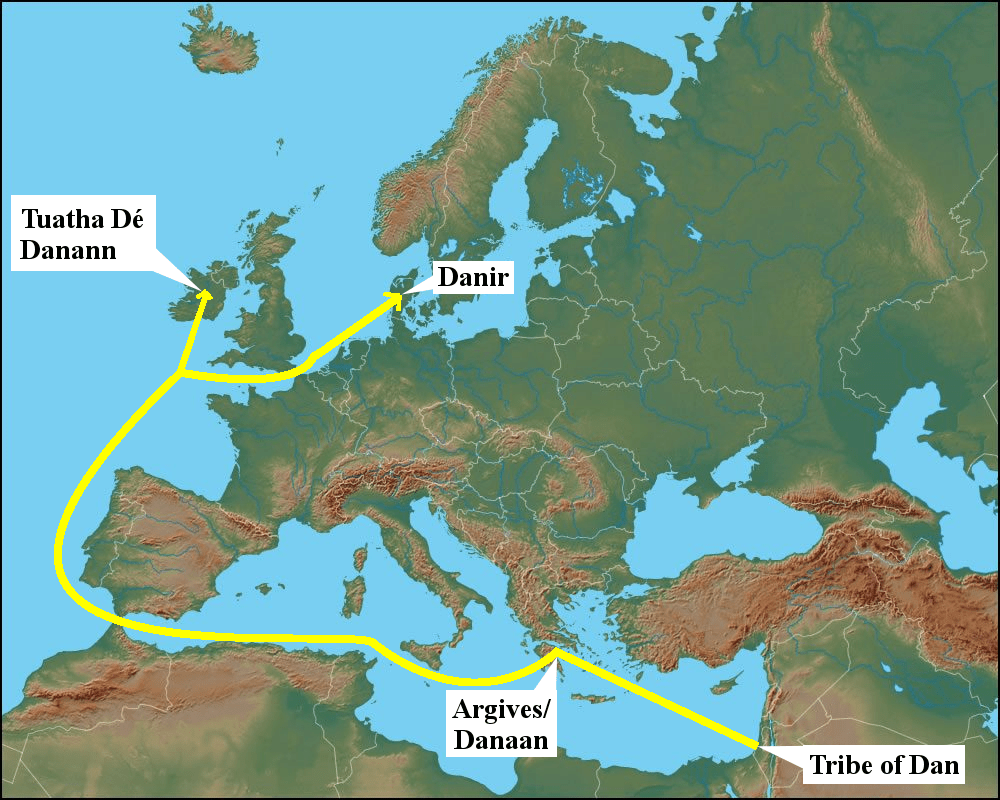
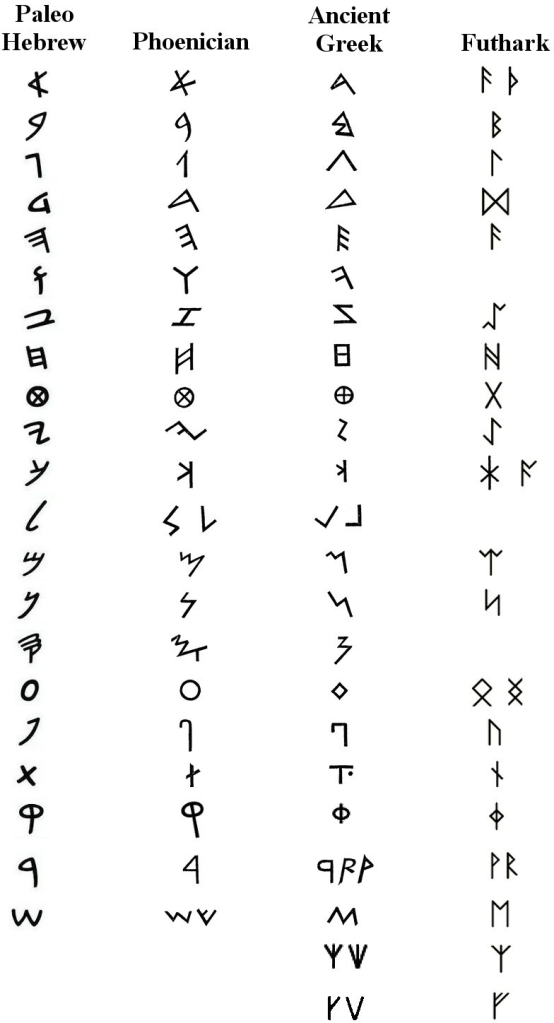
The haplogroups of the Indo-European and Scandinavian races can be traced back to ancient Israel. When the tribe of Dan was pushed out by the Philistines, the Danites sailed out west and settled in Greece (which they were known as the Danaan), and also sailed out from the Mediterranean Sea, around Europe and settled at the peninsula of what is now called Denmark. The Danites were the Danir (Danish), and the ancestors of the Nordic race proving beyond any reasonable doubt the racial identity of the original Israelites.
You can see in the tables below Dan’s migration route, and how the Runic (Futhark) alphabet evolved from Paleo-Hebrew.
David is described in the Bible as being “ruddy”, which means “red” and is a reference to blushing. A dark-skinned person does not have the ability to blush, logically this trait only applies to those with a light complexion.
Although the ancient Jews were descendants of the Babylonians, most of them today are descended from the Kingdom of Khazaria – a European empire of Mongols (Huns) and Turks whom decided to convert to Judaism and surreptitiously laid claim to the Israelite identity. Khazars are said to have descended from Esau the oldest son of Isaac (Edomites) and some from Japeth, one of Noah’s sons. Regardless of their ancestral heritage, the Khazars are the legitimate progenitors of the Ashkenazi (European) Jews.
To properly be regarded as an Israelite required more than just being a physical descendant of Jacob, it also required obedience and respect to God’s precepts. The ancient Israelites turned their backs on God on several occasions and became apostate, worshiping idols which are recorded in books such as Joshua and Judges causing God to expose them to various privations until they repented and returned to righteousness.
When Solomon lead the Israelites astray to the point where they refused to repent, God divorced Israel and caused them to go into the Babylonian and Assyrian captivities. An Israelite ceases to be regarded as such by failing to follow God’s commands and breaking His covenant.
[Deuteronomy 7:9-12] “And you shall know that יהוה your Elohim, He is Elohim, the trustworthy El guarding covenant and kindness for a thousand generations with those who love Him, and those who guard His commands, but repaying those who hate Him to their face, to destroy them. He does not delay to do so with him who hates Him, He repays him to his face. And you shall guard the command, and the laws, and the right-rulings which I command you today, to do them. And it shall be, because you hear these right-rulings, and shall guard and do them, that יהוה your Elohim shall guard with you the covenant and the kindness which He swore to your fathers”
The covenant between God and the Israelites is dependent upon them abiding by his perfect and loving will. Even Paul asserts this several times in the New Testament. Here’s one example taken from Romans:
[Romans 9:6-8] “However, it is not as though the word of Elohim has failed. For they are not all Yisra’el who are of Yisra’el, neither are they all children because they are the seed of Abraham, but, “In Yitsh’aq [Isaac] your seed shall be called.” That is, those who are the children of the flesh, these are not the children of Elohim, but the children of the promise are reckoned as the seed.
More evidence that the Jews are descendants of the Babylonians is recorded in the Book of Esther (written after the Babylonian exile) which is traditionally dated to the 3rd or 4th century BC. One of the main protagonists in this book is a character by the name of Mordecai, the name most commonly interpreted as “servant of Marduk”. Marduk was the chief god of the ancient Babylonian pantheon and was regarded and worshiped as the most high God. The book of Esther describes Mordecai (the servant of Marduk) as working “for the good of his people” and the “welfare of all the Jews.” Needless to say, this sheds light into the practices of the Jews and their apostate religion, and has no claim to the covenant of the Israelites and Yahweh.
After returning from the Exile, the Jews were aware that they had inherited the Mosaic religion from the tradition of their Judean ancestors, but refused to practice it. During the Maccabean revolt in the 2nd century BC, the inhabitants of Judea at that time had put the Pharisees (meaning “Persians”) in charge of the temple priesthood in place of their previous Hellenic leaders. The Pharisees in their attempt to lay claim to the priesthood departed from the Sadducees because of doctrinal differences and political reasons.
The Samaritan religion was the religion of the ancient Israelites prior to the Babylonian Exile, preserved by those who remained in the Land of Israel. The older Samaritan culture was a part of the Judean or Palestinian culture, but there is no longer a dominant Samaritan culture claiming to be directly descended from the ancient Judean culture. The modern-day Samaritans are not the same Samaritan culture as being discussed as that is an Arab culture. The Samaritan religion was the religion of Jesus, John the Baptist, and the prophets. Since Nazareth is located in Samaria proves beyond reasonable doubt the contrast between the Jews and the Israelites.
In the time of Jesus, the conversion of a Jew to the Samaritan religion was not as we would think of being converted from one religious sect or creed to another. Jesus and his disciples considered it a conversion from sin into righteousness. This is apparent in Paul’s epistles. Judaism rejects the message of Jesus because it is a Samaritan message, not a Jewish one.
After the sojourn in Babylon the native Samaritans were looked down on by the Jews for their righteousness, and this has caused Christians to take the Jewish position against them. It is also asserted that the Samaritans were a mixed race of Canaanites and Israelites, but this is no more true of the Samaritans than of the Jews. Essentially this argument supposes that the culture of Israel was separate from the culture of Judea (that is, the tribe of Judah). This is true; however, both of them were Palestinian cultures and both were annihilated by Mesopotamian nations.
The Samaritan identity was forged from those who were allowed to stay in Palestine and preserved the ancient Hebrew traditions. When the opposing groups returned, the conflict between the Israelites (also Galileans) and the Jews was purely ideological. The Jews had lost their ethnic identity; thus there was no longer a recognizable Judean culture. The tribes and the divisions between them had virtually ceased to exist, and upon their return there was confusion as to how the land would be divided again. This is how Judeans became Jews and how the land of Judah became Judea.
The prophets whom God sent to expose the iniquity of the Jews were from Samaria, and all of them practiced the Samaritan religion, which preceded Babylonian Judaism and the Mosaic religion of Israel. These prophets, including Jesus, went into the two kingdoms (the Kingdom of Israel and the Kingdom of Judah) to deliver God’s messages. In the pre-sojourn period their message was received better in Judah than in Israel, but after the sojourn and especially at the time of Jesus the opposite was true. The ignorant, bigoted Jews were contemptuous of both Galilee and Samaria.
[John 7:41] ‘Others said, “This is the Messiah,” but others said, “Does the Messiah then come out of Galilee?’
[John 7:52] They answered and said to him, “Are you also from Galilee? Search and see that no prophet has arisen out of Galilee.”
[John 1:46] And Nethane’l said to him, “Is it possible for any good matter to come out of Natsareth?” Philip said to him, “Come and see.”
The Nazarite culture in Nazareth was also part of the Samaritan religion. A Nazarite was a person who made a vow of separation from worldliness, observing a strict set of monastic rules. Some of these rules were of pacifism, chastity, veganism, and abstinence from alcohol and grapes. They were forbidden to approach dead bodies or anything called “unclean” by Moses, and were also forbidden to cut their hair. According to the Law of Moses, a person could be a Nazarite for as little as 30 days or for as long as his whole life, but if he became unclean, he would have to repeat some or all of the commitment.
The Nazarites who were set-apart “from the mother’s womb,” like Samson and John the Baptist, observed a different set of rules, and this accounts for the Judges’ use of violence as special agents of God’s wrath. The Nazarite was also usually allowed to cut his hair once a year if it became troublesome. The specific vows and stipulations of the Nazarites set down by Moses are mentioned briefly in the book of Numbers.
[Numbers 6:1-8] And יהוה spoke to Mosheh, saying, “Speak to the children of Yisra’el, and say to them, ‘When a man or woman does separate, by making a vow of a Nazirite, to be separate to יהוה, he separates himself from wine and strong drink—he drinks neither vinegar of wine nor vinegar of strong drink, neither does he drink any grape juice, nor eat grapes or raisins. All the days of his separation he does not eat whatever is made of the grapevine, from seed to skin. All the days of the vow of his separation a razor does not come upon his head. Until the days are completed for which he does separate himself to יהוה he is set-apart. He shall let the locks of the hair of his head grow long. All the days of his separation to יהוה he does not go near a dead body. He does not make himself unclean for his father, or for his mother, for his brother or his sister, when they die, because his separation to Elohim is on his head. All the days of his separation he is set-apart to יהוה”
[Numbers 6:18-20] “And the Nazirite shall shave the head of his separation at the door of the Tent of Meeting, and shall take the hair from the head of his separation and shall put it on the fire which is under the slaughtering of the peace offering. And the priest shall take the boiled shoulder of the ram, and one unleavened cake from the basket, and one unleavened thin cake, and put them upon the hands of the Nazirite after he has shaved his hair of separation. Then the priest shall wave them, a wave offering before יהוה It is set-apart for the priest, besides the breast of the wave offering and besides the thigh of the contribution. And afterwards the Nazirite shall drink wine.”
Being a Nazarite was all about living righteously—by focusing on the spirit of the law and living a natural lifestyle and this is why there was so much variation in the ordinances and they were hardly ever mentioned in the Pentateuch. Jesus contrasted between himself and John the Baptist and made known that he came eating bread and drinking wine, and it has also been recorded that he said, regarding the law, that “it is not that which goes into a man’s mouth but that which comes out of it that defiles him.” So, a Nazarite would only take vows that he had the capacity to fulfill. The vows were personal commitments tending toward holiness, and that the individual spirituality of the Nazarite was naturally at odds with the legalism of the hypocritical religion of the Jews.
When a Nazarite was separated, they were sent to Mt. Carmel to be educated at the mystery school of the bene amun (‘sons of truth’), and was known in the Bible as a place of refuge. Carmel was also the place where the transfiguration of Jesus took place. It was also the place where the prophet called “the man of God” dwelt, best evidenced by the detailed careers of Elijah and Elisha, two of the most famous Nazarites. Prophets who did not belong to this group were considered heretics during the Old Testament period.
The Nazarite community on Mt. Carmel was relatively small. It was a sacred wilderness for those who had little interaction with the outside world. Nazareth was right across the border of Galilee and it was a regional name for the Old Testament town near Mt. Carmel because the Nazarites and their families lived there. Joshua 19:15 names the town between Mt. Carmel and the closest city of Cana as Bethlehem, but this is not the same Bethlehem in Judea where Jesus was born. It is the city which David captured and made Zadok his high priest, as Bethlehem is the city of David.
Before the Pharisees took over the temple priesthood, it was populated by the Zadokites – a sect of Nazarites in the tradition of David’s high priest Zadok (meaning ‘righteous one’) and originally included the Sadducees (a variant of the same word) and the older school of prophets in Samaria. The Zadokites were a Dead Sea sect whom had contempt for the Pharisees and their teachings. They regarded sacrifice as an abomination, and is evidenced throughout the Old Testament. That Jesus was a part of this legacy is proven by his quoting of Hosea 6:6.
[Matthew 12:5-8] “Or did you not read in the Torah that on the Sabbath the priests in the Set-apart Place profane the Sabbath, and are blameless? But I say to you that in this place there is One greater than the Set-apart Place. And if you had known what this means, ‘I desire compassion and not offering,’ you would not have condemned the blameless. For the Son of Adam is Master of the Sabbath.”
This is not because the Zadokite customs conflicted with the Law of Moses, but rather the Zadokites reviled the Jews for choosing to sin and make atonement sacrifices instead of becoming righteous. This is exactly why the doctrines of Christianity, which make Jesus the scapegoat of humanity, are as detestable and offensive to God as those of the Jews. The mere fact that Jesus is made out to be the ritual sacrifice for our atonement is the pretext for our insistence that we go on sinning and even makes God culpable for his murder. God desired not that Jesus should die (necessarily), but rather that we should learn from him and reconcile ourselves to God without ritual atonement by which we cannot even please him. We have chosen not to; therefore, we have condemned the guiltless Jesus in an attempt to acquit ourselves.
The gospel is not a continuation of the law but rather a circumvention of it. The Nazarites, and Jesus in particular, divided the Old Testament into two parts, referring to them as “the law and the prophets” and sometimes as “Moses and the prophets.” This shows that there were two traditions in Judea at the time and a generally accepted synthesis of the two, being the common legalistic interpretation of the law of the Jews. The synthesis has become the Bible since the New Testament is little more than an addition to the prophetic tradition of the Nazarites. For instance, when the Pharisees asked John about his affiliation, they knew that because he was not one of them, he was either the anointed one or one of the prophets. They also asked if he was one of the priests or one of the Levites. If he was a priest from among them, they would not have had to ask, so the question was clearly whether or not he was a Zadokite priest unless they were just trying to determine whether he had any legal precedent for preaching so that they could punish him. The Zadokites were originally Levites, though it could not be known exactly who the Levites among them were a millennium after Zadok, but John was certainly the firstborn son of a Levite priest.
Now that the differences between Israelites and Jews have been addressed it should now be evident that Jesus was not Jew. Jesus’ mother Mary and her cousin (John’s mother) Elizabeth were both from the tribe of Judah as was their ancestor, David. Elizabeth’s husband Zechariah was a Levite priest with no inheritance so they retired to her native tribe of Judah when his service was over, but Mary’s situation had taken her away from Judah to Nazareth in Galilee. After she met with Elizabeth, they both took up permanent residence in Nazareth. It seems that Mary and Elizabeth were selected specifically because the whole family had connections to Nazareth prior to their settling there.
The passage from Luke 1:26-27 shows that Mary was already living in Nazareth and engaged to Joseph. This makes Joseph the original Nazarite of the family, before Zechariah’s conversion, and explains why Mary settled there even though she was from Judah. That Joseph and Mary were both from the house and line of David and the same extended family was necessary for the fulfillment of the prophecies made by other Nazarites privy to the secrets of their family traditions dating to before David’s own family settled in Judah. In fact, these traditions even predate Moses and the nation of Israel itself.
The Christ was not a man, but an ideal or a role of office. Jesus was a man who conformed to this ideal. The word ‘messiah’ is English for the Paleo-Hebrew word mosheh which comes from the Egyptian word for the oily fat of crocodiles used to anoint kings (in modern Hebrew, this would be mashiach, but Paleo-Hebrew did not string vowels together). Thus, the title of Christ applied to Jesus has a literal meaning of the one ‘anointed’ with the mosheh, and therefore included, among others, Moses (whose name is literally identical to Christ in Egyptian and Hebrew), King David who was anointed by the prophet Samuel (1 Samuel 16:13) and, for a time, King Solomon who was anointed by Zadok in the presence of the prophet Nathan (1 Kings 1:38). Since crocodiles spend so much time in the water, the Egyptian crocodile god Sobek was regarded as the son of Neith. Neith was the wife of Set who was the enemy of Osiris and Horus. Set’s name is the same as that of Adam’s son Seth, so the conflict between Set and Osiris is undoubtedly a metaphor for the feud between Adam’s offspring and either the nefilim or Satan’s offspring by Cain, or both.
After the unification of Upper and Lower Egypt, the city of Crocodilopolis was established in Lower Egypt and dedicated its temple to Neith. This is where the Sobek cult was situated. The Sobek cult and the Osiris cult were practiced in the same location. The Osiris cult was the predecessor of Luciferianism (Freemasonry, Illuminism) and the Sobek cult being the predecessor of Christianity (that is, the true Christianity of the first century Essene sect). The Osiris cult became the practiced religion of Egypt, but the Sobek mystery cult was the state religion up to and including part of the 18th dynasty; its secrets were only known to the literate upper class and only preserved by Moses, who took them back to Palestine.
By the Roman period the town of Crocodilopolis had become known as Arsinoe after the name of the nome (territorial division). After the destruction of Jerusalem, it became the new center of Samaritan culture. All this proves that the Nazarites’ knowledge of the mosheh was preserved until after the time of Jesus.
During the 1st century the area of Qumran was called Damascus, but this Damascus was not the same Damascus located in Syria, rather it was located outside of Jerusalem.
[Acts 26:19-20] “Therefore, Sovereign Agrippa, I was not disobedient to the heavenly vision, but declared first to those in Damascus and in Yerushalayim [Jerusalem], and in all the country of Yehuḏah, and to the gentiles, that they should repent, and turn to Elohim, and do works worthy of repentance.”
[Galatians 1:17] Neither did I go up to Yerushalayim [Jerusalem], to those who were emissaries before me. But I went to Araḇia, and returned again to Damascus.
Obviously, one cannot get to Arabia (as this means the Arabian Peninsula) from Jerusalem by way of Syria, which is in the opposite direction. Syria at that time was under Roman rule which the Pharisees had no jurisdiction over. The Book of Acts plainly states that the early Christians were persecuted by the Pharisees; thus, the Damascus community was not in Syria. Why the early Christians called their community Damascus is subject to speculation, perhaps as a way of encryption to hide their oppressed identity.
Paul had based his operation out of Jerusalem and its temple but only spent fifteen days there after the three years he spent in Damascus. This gives us some idea of how significant Damascus was as a religious and cultural center for the Christians of Judea. It was, in fact, the only such place set apart from the rest of the Judean culture as Nazareth in Galilee had been. There can be no doubt that Paul spent all that time learning the ancient doctrines of the Nazarenes which were new to him. There can also be no reasonable doubt that Paul’s reading material was contained in the Dead Sea Scrolls and that he himself personally studied the exact same parchments which have come to us.
Modern Christian denominations whom mimic the “church of Acts” have no understanding of the Damascus community because they are unfamiliar with the Dead Sea Scrolls because the Damascus of Judea is only otherwise known as Khirbet Qumran, a name which did not exist during the New Testament period. This community was not composed of ex-Jewish Christians, but of Nazarenes, or Essenes as they are called by Josephus. The suffix -ene is Greek for the Hebrew suffix -ite, so the Nazarenes were actually Nazarites, and essene is a Greek variation of Nazarene.
The Christians of Judea were the Ebionites (meaning ‘poor ones,’ cf. “blessed are those who are poor in spirit,” Matthew 5:3), the Christian faction of Essenes. Other factions of Essenes were known as Osseans, Elkasaites, Nazoreans, and Marcionites, to name a few, and these were the Gnostic sects which were regarded as heretics by the Christians; those whom Paul warned were “preaching another Gospel” in his second letter to the Corinthians, and whom John warned were “denying Jesus came in the flesh” in his first epistle.
The Ebionites could not have been Jews because the Jews were of the Pharisee and Sadducee persuasions. There was another sect that Josephus called the Zealots, a faction of Pharisees whom were radical Judean nationalists obsessed with waging war against their Roman oppressors. They were so radical, in fact, that they were opposed to anyone who didn’t share in their cause for war, and even murdered people who spoke out against them. The Ebionites, however, were strictly opposed to violence and refused to participate in the Zealots’ thirst for blood; thus, the two factions were opposed to each other. There were some Jews who were influenced by the Essenes, whom wrote the War Scroll and Temple Scroll, but there was no such thing as an “Essene Jew” being that the Essenes were opposed to sacrifice.
The Dead Sea Scrolls found in the caves of Qumran were not all written by Essenes. Only, it was the place where the scrolls written by the Jewish and Essene sects, and other various writings were collected and stored. The only known scroll that was written by the Christians found at the Qumran is the Community Rule (1QS). This and the Damascus Document found in Cairo are the only known scrolls that were written by the Christians.
In the Damascus community, a title known as Teacher of Righteousness was referred to a prophet of God who could also interpret other prophets. The origins of the community and the Teacher of Righteousness are described in the so- called Damascus Document, which was actually discovered in the Cairo Geniza. Fragments of it have also been found among the Dead Sea Scrolls. This document set down the laws, admonition and communal rules of the Damascus community.
The title that Jesus was known by his disciples was rabbi (meaning ‘my teacher’). John is also called rabbi (John 3:26) which suggests that all Nazarites which strayed from their community at Mt. Carmel were called by that title. Even though the term is now applied to Jewish scholars, no other group ever used that title among the Judean religious leaders of Jesus’ time apart from its application to the “teachers of the law,” of whom Jesus declares his contempt for their prideful desire to be known as such. The disciples of both Jesus and John are also distinguished from the other Judeans, a theme echoed throughout the gospel (e.g., John 3:25), because they were simply not Jews.
John’s disciples who flocked to Jesus also followed him to Nazareth and then proclaimed he was the mosheh the same day. This could have only happened if they had been expecting the mosheh to come from Nazareth and found verification by the community there or were just simply convinced by John on the very first day of his ministry. Either way they had to have been familiar with what the role entailed. Andrew’s words to Peter would have been meaningless to him otherwise.
[John 1:38-41] And יהושע turning, and seeing them following, said to them, “What do you seek?” And they said to Him, “Rabbi” [which means Teacher], “where are You staying?” He said to them, “Come and see.” They went and saw where He was staying, and remained with Him that day. Now it was about the tenth hour. Andri, the brother of Shim‛on Kĕpha [Peter], was one of the two who heard from Yoḥanan [John], and followed Him. First he found his own brother Shim‛on, and said to him, “We have found the Messiah” [which means the Anointed].
If he had not already been known as a teacher then Jesus would have been called a prophet just as John had been. Even the Pharisees who thought John was a prophet, and scorned them both, called Jesus rabbi. The reason drawn from the Bible is that they associated miracles with divine inspiration and that same inspiration with the office of the Teacher of Righteousness. Like the title mosheh, Teacher of Righteousness was seen as a vocation and was used as a personal means of addressing Jesus. Even his enemies referred to him as such.
[John 3:2] This one came to יהושע by night and said to Him, “Rabbi, we know that You are a teacher come from Elohim, for no one is able to do these signs You do if Elohim is not with him.”
Damascus was not known until after Jesus’ resurrection. (The community is dated according to the date of writing of the Dead Sea Scrolls, which itself is still in dispute. However, Damascus existed from at least the time of Moses, as it is used as a reference point in Genesis 14:15.). This means that the title was passed to his immediate successor John the Evangelist. Scripture proves that this continuity was extant even during Jesus’ ministry.
[John 3:11-12] “Truly, truly, I say to you, We speak what We know and witness what We have seen, and you do not receive Our witness. If you do not believe when I spoke to you about earthly matters, how are you going to believe when I speak to you about the heavenly matters?”
Jesus always used the first-person singular pronoun when describing his oneness with the Father. “We” being used here is Jesus speaking on behalf of his Nazarite sect or just himself and John the Baptist. This disproves the notion that Christ’s ministry was a unique event in history and there is more evidence in the Bible that the knowledge of the mosheh existed long before the time of Jesus.
Three millennia ago, the Zadokites requested that the temple be constructed at Mt. Gerizim but David chose Mt. Zion in Jerusalem for its location instead. As a result, the Samaritans built a temple at Mt. Gerizim after the exile in opposition to the temple in Jerusalem, which became the Synagogue of Satan when Solomon was in power. It was destroyed by the Hasmonean king John Hyrcanus, an act which had much to do with the outright hostility between the Jews and the Samaritans. Zadokites, like the school of prophets at Mt. Carmel, hoped that the temple priesthood at Jerusalem would be restored and they diverged from the other Samaritans in this regard. (Zadok was, after all, the first high priest of the temple in Jerusalem, and his ancestors were kings of that city.)
The Samaritan woman of John 4 knew that all prophets came from Nazareth and equates Jesus’ ability to prophesy with the more rustic form of mountain worship at Mt. Carmel. (The temple at Mt. Gerizim had already been destroyed.) Based on this association, she expected him to be opposed to the priesthood in Jerusalem and to tell her that Jerusalem ought to be reclaimed, but instead he caught her by surprise by telling her that God will abolish both forms of worship. Modern translations depict Jesus himself as lying and saying that he was a Jew in this context, and Bible scholars circumvent the woman’s logic by claiming that she was changing the subject, implying that being a prophet and claiming that God should be worshiped in Jerusalem are unrelated. However, her statement that he was a prophet should be read with the understanding that she knew that all the prophets were from Samaria, and that they therefore had this knowledge in common even though she had immediately recognized him as ethnically Judean. That someone so far removed from the theological debates of the Sanhedrin knew of the Zadokites’ longing to be restored in Jerusalem is proof that these issues were well-known at the time.
The Samaritan woman also knew that the mosheh was a Teacher of Righteousness who would reveal the meanings of the mysteries. This also shows that the Samaritans were expecting the mosheh and that they had a much better understanding of what the mosheh does than did the Jews who were expecting a son of David to overthrow their Roman oppressors.
[John 4:25] The woman said to Him, “I know that Messiah is coming, the One who is called Anointed. When that One comes, He shall announce to us all.”
The religion of Jesus and the Zadokites predates the Law of Moses. It is known as the Order of Melchizedek. As written in Genesis, Melchizedek was an ancient priest-king of Salem and priest of Yahweh, and was revered by Abraham. The Jews scorned the native people of Palestine (Samaritans and Canaanites alike) who were there before them because they were not born to the same families, and in so doing they scorned the more ancient and more perfect form of religion acknowledged even by their father Abraham. This is why David, himself a Zadokite, chose Jerusalem to build his temple rather than Gerizim out of respect for the ancient tradition of the order of Melchizedek.
[Genesis 14:18-20] And Malkitseḏeq sovereign of Shalĕm brought out bread and wine. Now he was the priest of the Most High Ěl. And he blessed him and said, “Blessed be Aḇram of the Most High Ěl, Possessor of the heavens and earth. And blessed be the Most High Ěl who has delivered your enemies into your hand.” And he gave him a tenth of all.
Although Melchizedek is the name ascribed to this order it actually dates back much earlier, at least to Enoch, but probably even before him to Seth or possibly to Adam or Abel, though with interrupted transmission. The first person chronologically to be called the Teacher of Righteousness is Enoch in the Syriac Apocalypse of Paul. Jude, who has been shown to have quoted directly from the Book of Enoch, also says that Enoch was a prophet and enumerates his descent from Adam (Jude 14).
Melchizedek means ‘king of righteousness’ and it is an early title for the Teacher of Righteousness of the Dead Sea Scrolls and the mosheh of the Bible. Noah is also called a “preacher of righteousness” in the New Testament (2 Peter 2:5), indicating that there are several other possible titles for the one we call the Christ and that they were thought to be patrilineal descendants of Seth all the way to the Levite priesthood of Moses and Aaron.
With this new understanding we can substitute ‘the Teacher’ or ‘the King’ wherever Melchizedek and Christ appear in the Bible in order to recognize the Bible’s true message which the Synagogue of Satan have hidden from Christians for seventeen centuries.
[Psalm 110:1-4] יהוה said to my Master, “Sit at My right hand, until I make Your enemies a footstool for Your feet.” יהוה sends Your mighty sceptre out of Tsiyon [Zion]. Rule in the midst of Your enemies! Your people volunteer in the day of Your might, in the splendours of set- apartness! From the womb, from the morning, You have the dew of Your youth! יהוה has sworn and does not relent, You are a priest forever according to the order of Malkitsedeq.”
Here is the empirical proof that it was known a millennium in advance that the high priest of the Most High God, the priest after the order of Melchizedek, would be a Nazarite from the womb. Whether it was the ‘king of peace,’ Melchizedek himself, or someone before him, or whoever started this tradition did so a very long time ago—at least another full millennium before David penned the words which Jesus used to finally silence the ignorant Pharisees once and for all.
[Matthew 22:41-46] And when the Pharisees were gathered together, יהושע asked them, saying, “What do you think concerning the Messiah? Whose Son is He?” They said to Him, “The Son of Dawiḏ.” He said to them, “Then how does Dawiḏ in the Spirit call Him ‘Master,’ saying, ‘יהוה said to my Master, “Sit at My right hand, until I make Your enemies a footstool of Your feet”’? If then Dawiḏ calls Him ‘Master,’ how is He his Son?” And no one was able to answer Him a word, and from that day on no one was bold enough to ask Him any more questions.
As we can see now, Jesus was not a Jew, but a Nazarite (Zadokite priest) of the Order of Melchizedek. This age-old rumor that “Jesus was a Jew” is now apparent that it is just that—a rumor, as well as a blatant lie in order for Jews to gain support from Christians to push their Zionist agenda, which is to establish the Third Temple to usher in the Antichrist and the abomination of desolation. Zionists falsely lay claim to the Judaite identity, making themselves the Synagogue of Satan (Revelation 2:9, 3:9).
[Hebrews 5:5-10] So also the Messiah did not extol Himself to become High Priest, but it was He who said to Him, “You are My Son, today I have brought You forth.” As He also says in another place, “You are a priest forever according to the order of Malkitsedeq,” who, in the days of His flesh, when He had offered up prayers and petitions with strong crying and tears to Him who was able to save Him from death, and was heard because of His reverent fear, though being a Son, He learned obedience by what He suffered. And having been perfected, He became the Causer of everlasting deliverance to all those obeying Him, having been designated by Elohim a High Priest “according to the order of Malkitsedeq,”
[John 8:38-43] “I speak what I have seen with My Father, and you do what you have heard from your father.” They answered and said to Him, “Aḇraham is our father.” יהושע said to them, “If you were Aḇraham’s children, you would do the works of Aḇraham. But now you seek to kill Me, a Man who has spoken to you the truth which I heard from Elohim. Aḇraham did not do this. You do the works of your father.” Then they said to Him, “We were not born of whoring, we have one Father: Elohim.” יהושע said to them, “If Elohim were your Father, you would love Me, for I came forth from Elohim, and am here. For I have not come of Myself, but He sent Me. Why do you not know what I say? Because you are unable to hear My Word. You are of your father the devil, and the desires of your father you wish to do. He was a murderer from the beginning, and has not stood in the truth, because there is no truth in him. When he speaks the lie, he speaks of his own, for he is a liar and the father of it.”
[Matthew 15:3] But He answering, said to them [scribes and Pharisees], “Why do you also transgress the command of Elohim because of your tradition?
[John 5:45-47] Do not think that I shall accuse you to the Father. There is one who accuses you: Mosheh, in whom you have set your expectation. For if you believed Mosheh, you would have believed Me, since he wrote about Me. But if you do not believe his writings, how shall you believe My words?
[Luke 11:47-51] “Woe to you, because you build the tombs of the prophets, and your fathers killed them. “So you bear witness that you approve of the works of your fathers, because they indeed killed them, and you build their tombs. “And because of this the wisdom of Elohim said, ‘I shall send them prophets and emissaries, and some of them they shall kill and persecute,’ so that the blood of all the prophets which was shed from the foundation of the world shall be required of this generation, from the blood of Heḇel [Abel] to the blood of Zeḵaryah [Zechariah] who perished between the altar and the Dwelling Place. Yea, I say to you, it shall be required of this generation.
[1 Thessalonians 2:14-16] For you, brothers, became imitators of the assemblies of Elohim which are in Yehuḏah in Messiah יהושע, because you also suffered the same treatment from your own countrymen as they also from the Jews, who killed both the Master יהושע and their own prophets, and have persecuted us, and who displease Elohim and are hostile to all men, forbidding us to speak to the gentiles that they might be saved, so as to fill up their sins always. But the wrath has come upon them to the utmost.
[Matthew 27:19-20, 24-25] While Pilate was sitting on the judgment seat, his wife sent him this message: “Have nothing to do with that innocent man, for I have suffered terribly in a dream today because of Him.” But the chief priests and elders persuaded the crowds to ask for Barabbas and to have Jesus put to death. [. . .] When Pilate saw that he was accomplishing nothing, but that instead a riot was breaking out, he took water and washed his hands before the crowd. “I am innocent of this man’s blood,” he said. “You bear the responsibility.” All the people answered, “His blood be on us and on our children!”
 kohreinur.org